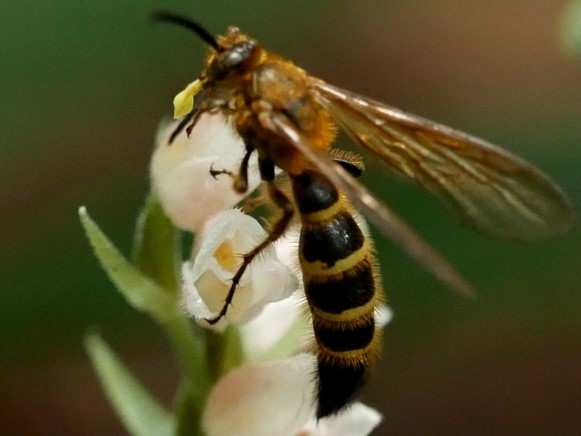


A remarkable resistance to venom has been discovered in a frog that feasts on hornets despite their deadly stingers. This frog could potentially serve as a model organism for studies on mechanisms underlying venom tolerance.
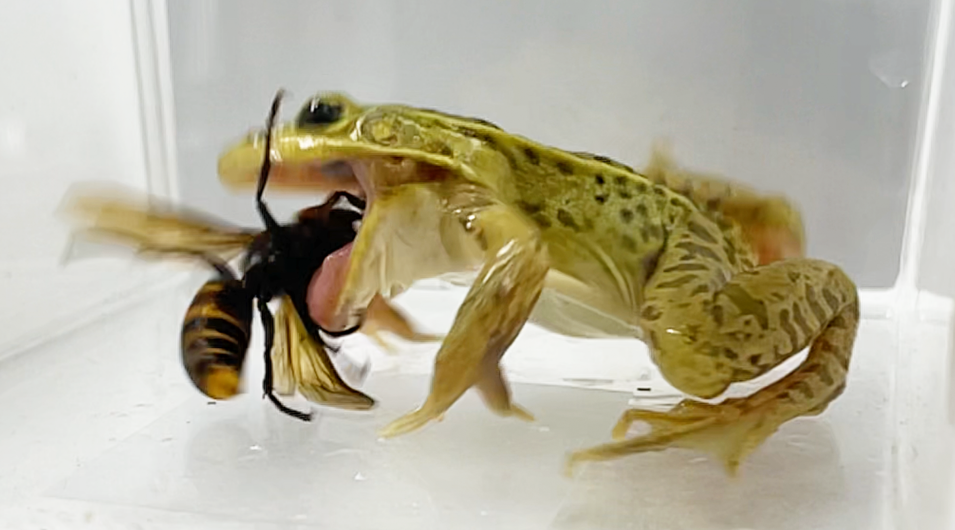
Kobe University ecologist SUGIURA Shinji discovered that the black-spotted pond frog seems to be unharmed and undaunted by venomous stings from hornets such as the Asian giant hornet, the largest in the world. © Shinji Sugiura, Ecosphere 2025 (DOI 10.1002/ecs2.70457) (CC BY)
While just the sight of a hornet’s stinger is enough to fill many of us with dread, some animals, such as some birds, spiders and frogs, are known to prey on adult hornets. The venom injected by their stingers can cause sharp, intense pain as well as local tissue damage and systemic effects such as destruction of red blood cells and cardiac dysfunction, which may even be fatal. But whether the animals that hunt hornets are able to tolerate the venomous stings, or just manage to avoid them, has remained unclear. “Although stomach-content studies had shown that pond frogs sometimes eat hornets, no experimental work had ever examined how this occurs,” says Kobe University ecologist SUGIURA Shinji.
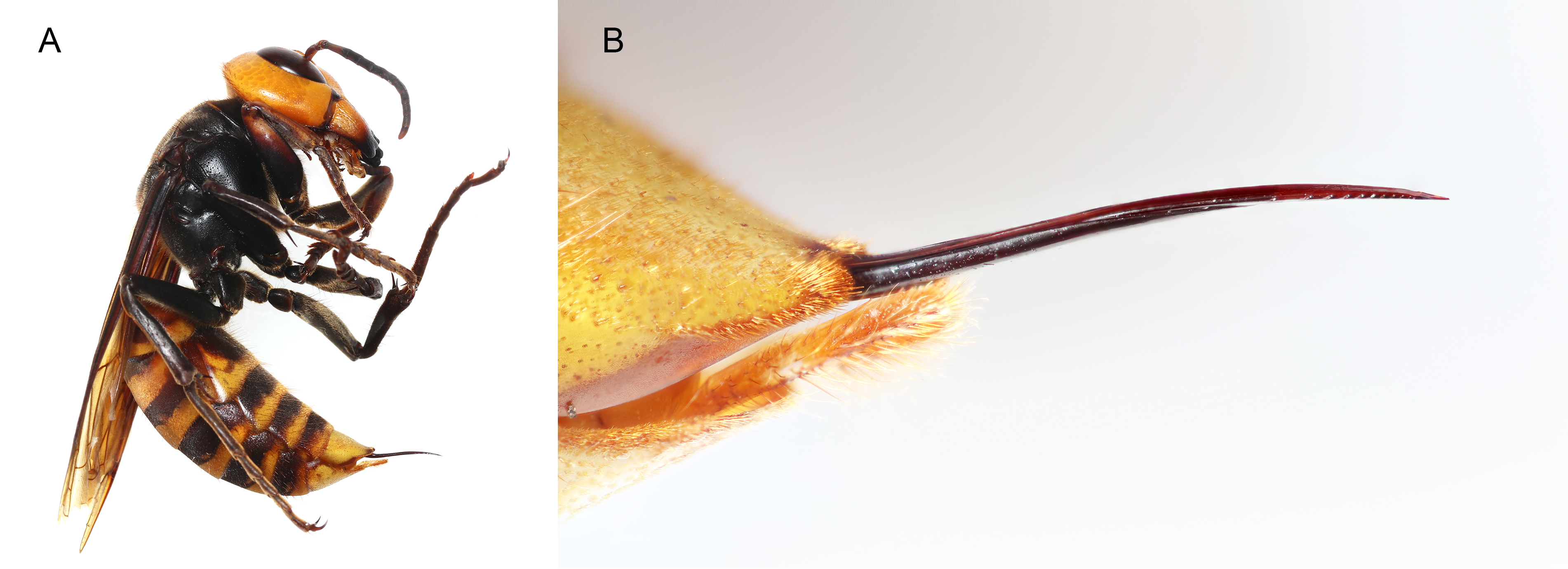
The venomous stinger of an Asian giant hornet (Vespa mandarinia). The venom injected by this stinger can cause sharp, intense pain as well as local tissue damage and systemic effects such as destruction of red blood cells and cardiac dysfunction, which may even be fatal. © Shinji Sugiura, Ecosphere 2025 (DOI 10.1002/ecs2.70457) (CC BY)
To test whether frogs avoid or tolerate these potentially deadly hornet stings, Sugiura presented individual adult pond frogs with workers of three hornet species, Vespasimillima, V. analis, and V. mandarinia, under laboratory conditions. Each frog was used only once, and was matched to fit the size of their prospective hornet prey, with larger frogs preferentially matched with Asian giant hornet (V. mandarinia) prey.
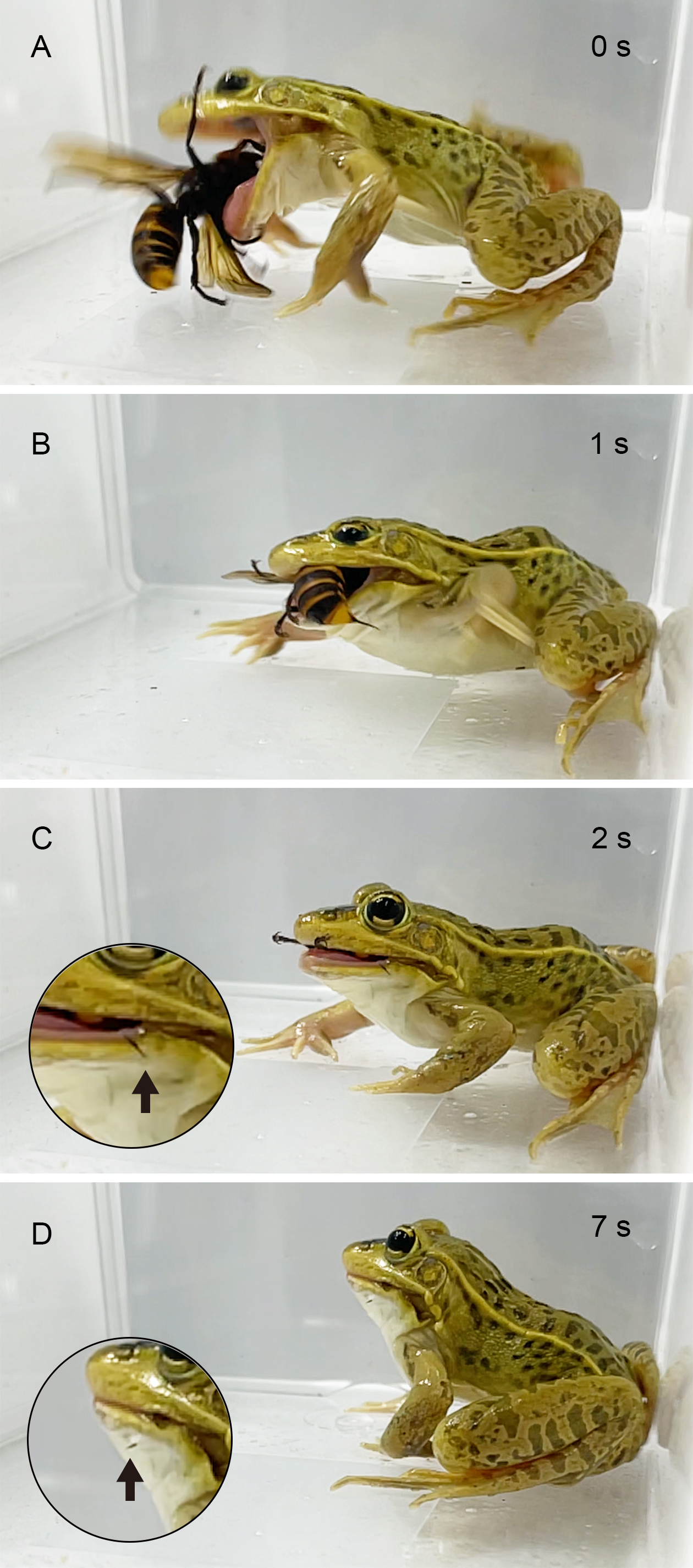
The black-spotted pond frog shows remarkable tolerance to venomous stings from an Asian giant hornet. The stings caused no visible harm and the frog behaved normally after predation. Close-up views of the hornet’s stinger embedded in the frog’s mouth are shown in the circular insets in (C) and (D). © Shinji Sugiura, Ecosphere 2025 (DOI 10.1002/ecs2.70457) (CC BY)
In the journal Ecosphere, Sugiura submits striking evidence that adult pond frogs actively attacked workers of the three hornet species. What’s more, he also reports that 93%, 87%, and 79% of frogs ultimately consumed V. simillima, V. analis, and V. mandarinia, respectively, despite being stung into the mouth or even into the eyes. “While a mouse of similar size can die from a single sting, the frogs showed no noticeable harm even after being stung repeatedly. This extraordinary level of resistance to powerful venom makes the discovery both unique and exciting,” says Sugiura.
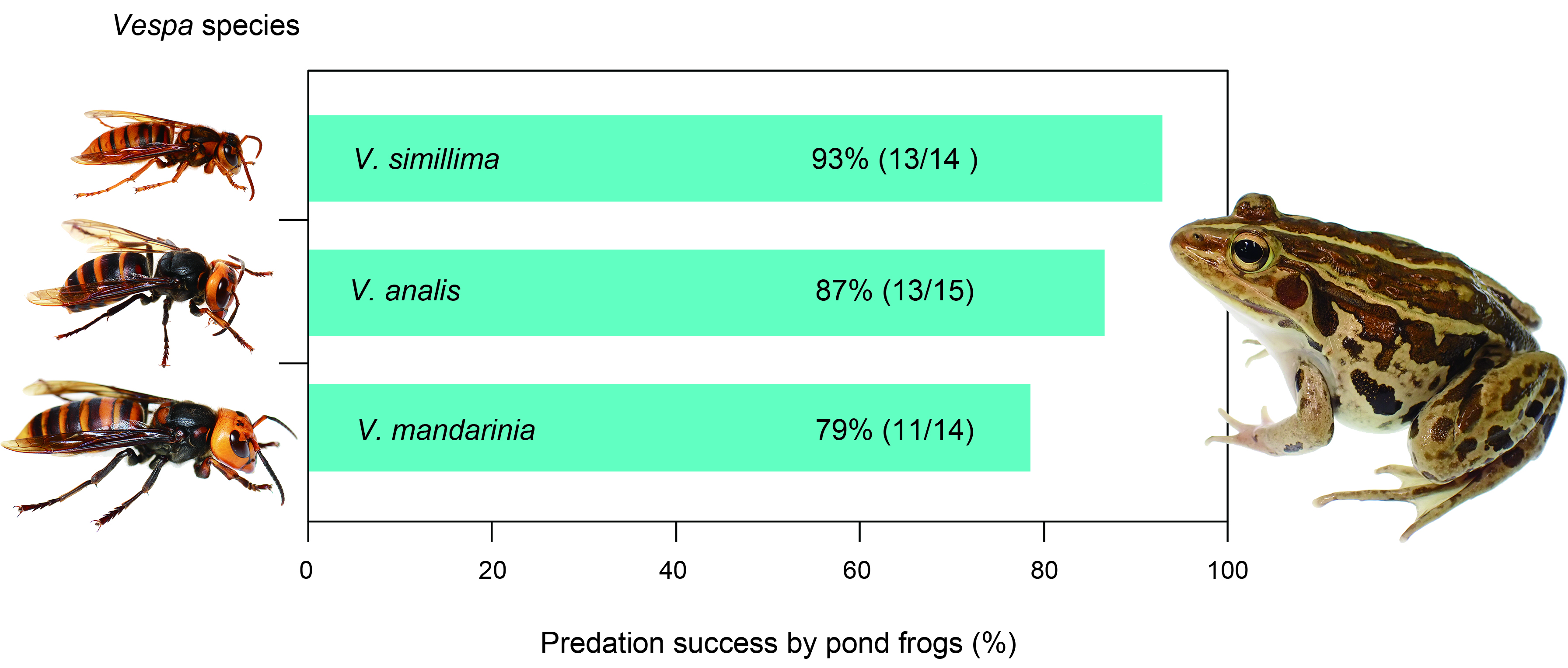
Almost all frogs in the study attacked the hornets, and although the hornets stung the frogs repeatedly, 93%, 87%, and 79% of frogs ultimately consumed Vespa simillima, V. analis, and V. mandarinia, respectively. © Shinji Sugiura, Ecosphere 2025 (DOI 10.1002/ecs2.70457) (CC BY)
Previous studies have suggested that pain and lethality of venomous stings are not necessarily correlated, with some stinging bees, wasps and ants delivering extremely painful, non-lethal stings while others cause little pain despite high lethality. This could mean that the frogs in this study have developed a double tolerance to these stings, which has enabled them to successfully prey on hornet workers.
“This raises an important question for future work,” he adds, “namely whether pond frogs have physiological mechanisms such as physical barriers or proteins that block the pain and toxicity of hornet venom, or whether hornet toxins have simply not evolved to be effective in amphibians, which rarely attack hornet colonies.” These frogs could, therefore, also serve as valuable model organisms for studying the physiological mechanisms underlying venom tolerance and pain resistance in vertebrates moving forward.
Acknowledgements
This research was funded by the Japan Society for the Promotion of Science (grants JP23K18027, JP24K02099).
Original publication
S. Sugiura: Pond frog as a predator of hornet workers: High tolerance to venomous stings. Ecosphere (2025). DOI: https://doi.org/10.1002/ecs2.70457
Release on EurekAlert!
Fearless frogs feast on deadly hornets
Inquiries
For inquiries, please contact gnrl-intl-press[@]office.kobe-u.ac.jp