

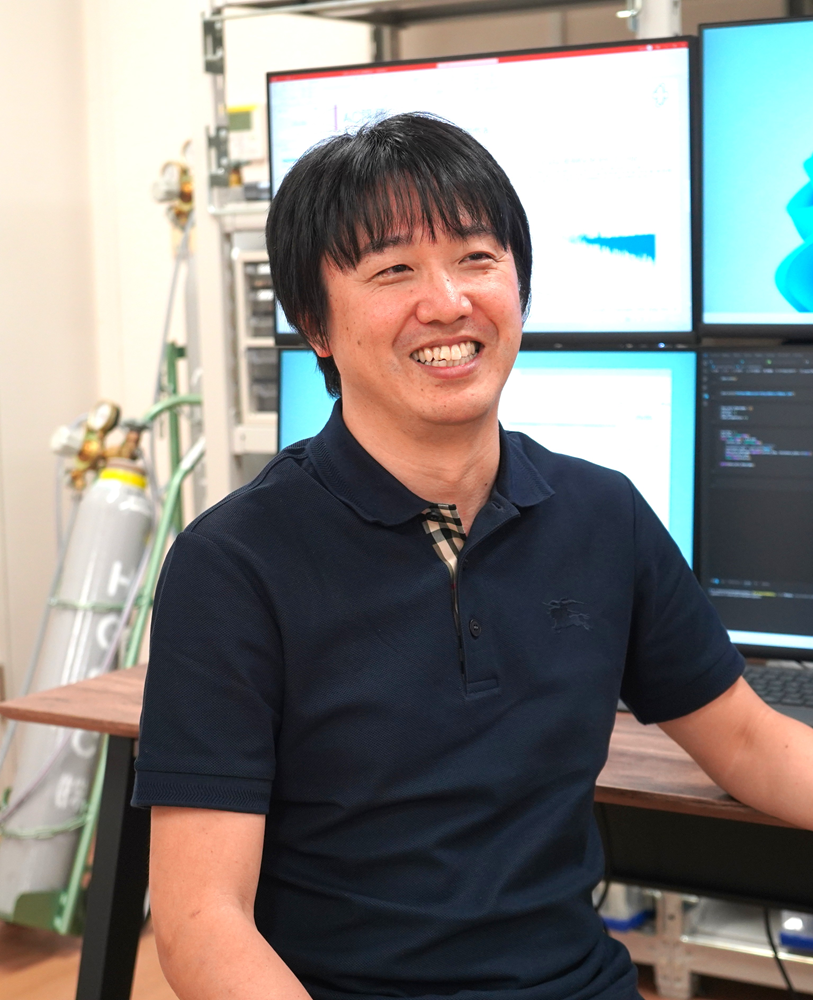
Once called a “pipe dream,” quantum computers are now approaching practical use. Companies and research institutes around the world are in fierce competition to develop this revolutionary technology, which has the potential to rapidly perform some calculations that are extremely difficult for even conventional supercomputers. But what exactly is possible through quantum computers, and where do we currently find ourselves on the road to practical use? We sat down to talk with Professor MIKI Takuji of the Graduate School of Science, Technology and Innovation to hear more about the latest trends and future developments in the field.
Growing computational demands in an advanced information society
What are quantum computers exactly?
Miki:
Quantum computers operate on the principles of quantum mechanics, which describes phenomena at extremely small scales, such as atoms and electrons. While conventional computers process information using bits that take a value of either 0 or 1, quantum computers use quantum bits, or qubits, which can exist in a “superposition” of the 0 and 1 states. By taking advantage of this and other quantum phenomena, quantum computers can process multiple possibilities simultaneously for certain types of calculations.
One prominent application is in calculations for chemistry. To give an example, let’s take calculations necessary for developing things like new medicine or materials. When one attempts to simulate a microscale chemical reaction, using a conventional computer would require a ton of calculations and, as a result, a ton of time. If you use a quantum computer, however, such calculations could potentially take dramatically less time.
However, the types of calculations that quantum computers excel at performing are limited, meaning that they can’t just speed through any calculation. That being said, there are some very important calculations among that group. One of those is prime factorization; in other words, it’s breaking an integer into a product of prime numbers (i.e. integers greater than 1 that are divisible only by 1 and themselves). Conventional computers aren’t great at this type of calculation.
What is behind the sudden spotlight on quantum computers in recent years?
Miki:
Now that we’ve entered an advanced information era, we’re currently seeing a sudden increase in the number of calculations we have our computers perform. Applications such as AI and self-driving cars require enormous amounts of computation, and that number is only going to increase moving forward. Quantum computers are gathering attention as a new computing technology that can respond to those sudden changes.
If practical quantum computers can be realized, they could also help reduce the energy required for computation. When supercomputers perform calculations over a long period of time, they require a massive amount of energy, but if we can use quantum computers to do the same calculations in a short amount of time, it’s possible to decrease energy usage. It’s quite important to look at it from that perspective.
Cooling is key to quantum computing
Tell me about the research you’re currently conducting.
Miki:
Quantum computers contain basic units called quantum bits, or “qubits,” which handle the calculations. There are several types of qubits, such as superconducting qubits, used by companies like Google, as well as trapped-ion and neutral-atom qubits. Our research group works with a type called “silicon spin qubits.”
Silicon is already used as a material for semiconductors, so silicon spin qubits can be built using existing semiconductor technology. One of the characteristics of these silicon spin qubits is their ease of integration; in other words, multiple qubits can be densely integrated on a single chip. In order to improve the precision of calculations made by these quantum computers, we need a large number of qubits, and these silicon spin qubits are expected to provide an advantage in increasing that number.
Currently, a significant issue with quantum computers is the tendency for errors to occur during calculations. In order to limit these errors, we need a technique called quantum error correction, which uses a large number of qubits. At the moment, we’ll need something in the order of one million qubits to achieve practical quantum computing.
The superconducting quantum computer announced last year by RIKEN and Fujitsu has 256 qubits. That makes it one of the largest superconducting quantum computers available to external users. I imagine we’ll see quantum computers with 1,000 or even 10,000 qubits within the next decade or so. Our research group is also attempting to increase the number of qubits using our silicon spin qubits.
What kind of approach is required to increase the number of qubits?
Miki:
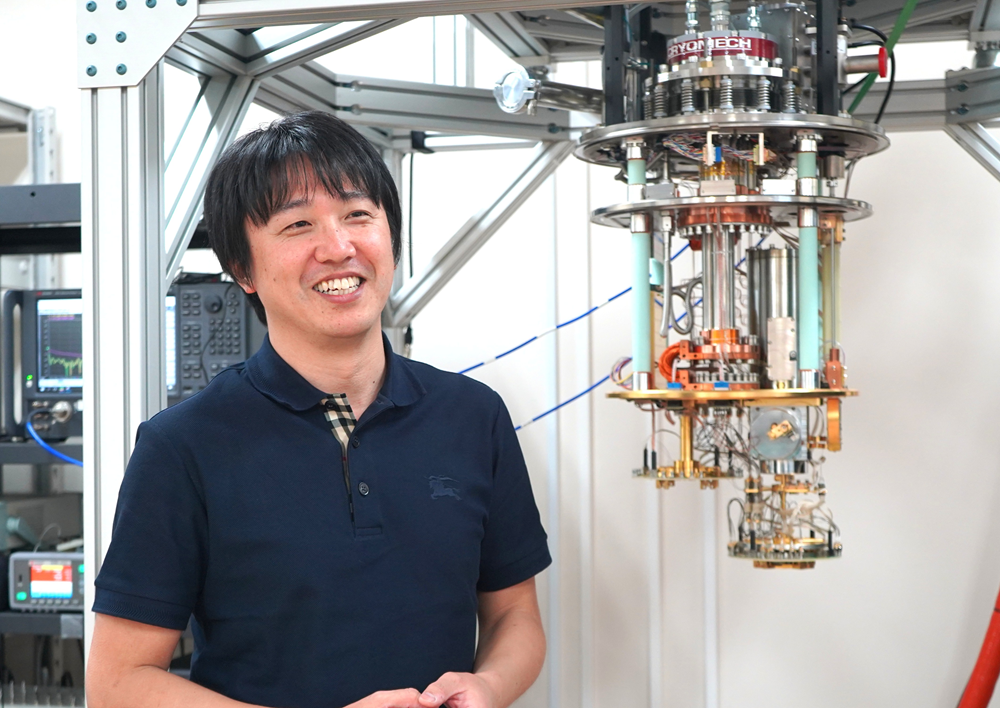
First and foremost, when working with many types of qubits, they need to be cooled. Since we live in a room-temperature world with a significant amount of thermal noise, it’s difficult to observe and maintain quantum phenomena. To suppress the noise, you need to use a device called a cryogenic refrigerator to lower the temperature close to absolute zero (-273.15 ℃).
However, increasing the number of qubits also increases the wiring used to control them, meaning external heat can enter into the cryogenic environment. Thus, as a solution to this, we came up with a method to place the control circuit itself into the cryogenic refrigerator.
On the other hand, when using this method, the semiconductor circuits used in the control unit need to be able to function under extremely low temperatures. Semiconductor devices aren’t generally designed for operation at extremely low temperatures, so we need to look closely at how they behave at temperatures close to absolute zero. We don’t yet have an accurate operational model, so our days are spent making estimations and performing experiments as part of our research.
Also, the control unit consumes power, which generates heat and raises the temperature within the cryogenic refrigerator. When this happens, the performance of the qubits degrades, so another important obstacle for us to overcome is creating a control unit that consumes extremely low power.
Using quantum technology to counter the threat of encryption being cracked
When do you think quantum computers will become practical?
Miki:
If we use the million qubit scale as a benchmark, at our current pace, I’d say maybe between 2035 and 2040. There are even corporations who are aiming for around 2030, so things could accelerate further.
I mentioned before that there are various types of qubits, but there’s still no clear winner. Moving forward, one type may eventually become dominant, or different types may coexist, each with its own strengths and weaknesses.
I also hear that new challenges could arise as quantum computers become a reality.
Miki:
Earlier, I mentioned that prime factorization is difficult for conventional computers. Some encryption methods take advantage of this difficulty.. It’s said that part of the encryption technology used in modern communications would take even supercomputers years to decrypt. Quantum computers, however, could potentially break such encryption.
One of the reasons why countries around the world are putting resources into quantum computer research is for that exact reason. Encryption is even used in military technology, so quantum computers have the potential to destroy conventional security systems. To counter this, research is currently being conducted on “post-quantum cryptography,” which is difficult for even quantum computers to decrypt, and quantum key distribution, which utilizes the basic principles of quantum physics.
It’s important to voice these concerns; I even make my students write reports on them in my classes. Quantum computer technology is wonderful, but I think it’s important to conduct research and education while also keeping ethical aspects in mind.
How will quantum computers be used in the future?
Miki:
Drug discovery and the development of new materials are a couple of areas that are expected to see huge strides. They also hold promise for use in AI and for financial simulations.
Looking at global challenges, we may be able to artificially reproduce a process such as photosynthesis that converts sunlight into chemical energy. It’s difficult to recreate a chemical reaction formula that produces energy from sunlight and CO2, but by using quantum computers, there’s a possibility that we may be able to find a catalyst suitable for artificial photosynthesis.
That said, I don’t think we’ll have one computer per person like we have with conventional computers. Rather, I think there will be quantum computers set up at data centers for many people to use.
Even if we realize practical quantum computers, the types of calculations that quantum computers excel at are limited, so we’ll still have conventional computers. This is actually very important; I want to emphasize that this does not mean that all computers will be replaced by quantum computers.
Interdisciplinary co-creation combining quantum technology with medicine and biotechnology
You previously conducted research in industry. How is that experience serving you in your current work?
Miki:
I’ve been studying semiconductor integrated circuits since I was a student, and I also conducted research related to semiconductors while at Panasonic. The skills and expertise I developed during my time in industry form the basis of my current research.
In fact, when I left the company to join Kobe University in 2017, I didn’t think I would be doing research on quantum computers. However, two years later in 2019, Google claimed that they had achieved “quantum supremacy,” demonstrating that a quantum processor could outperform conventional computers on a specific computational task. This was shocking to me. Quantum computers were no longer just theory; they had entered the engineering stage.
I had always been interested in engineering, which is why I decided to pursue it as my field of study. Now that quantum computers have entered a new phase on the road to commercialization, engineering researchers like myself have more opportunities to contribute.
Please tell me about the prospects of your research moving forward.
Miki:
Since 2020, I’ve been part of a project in the Moonshot Research & Development Program, a large-scale research program funded by the Japanese government, carrying out research with RIKEN and various corporations and universities. My team includes many researchers leading the field of silicon quantum computer research in Japan. Our current goal is to demonstrate a certain level of progress by 2030.
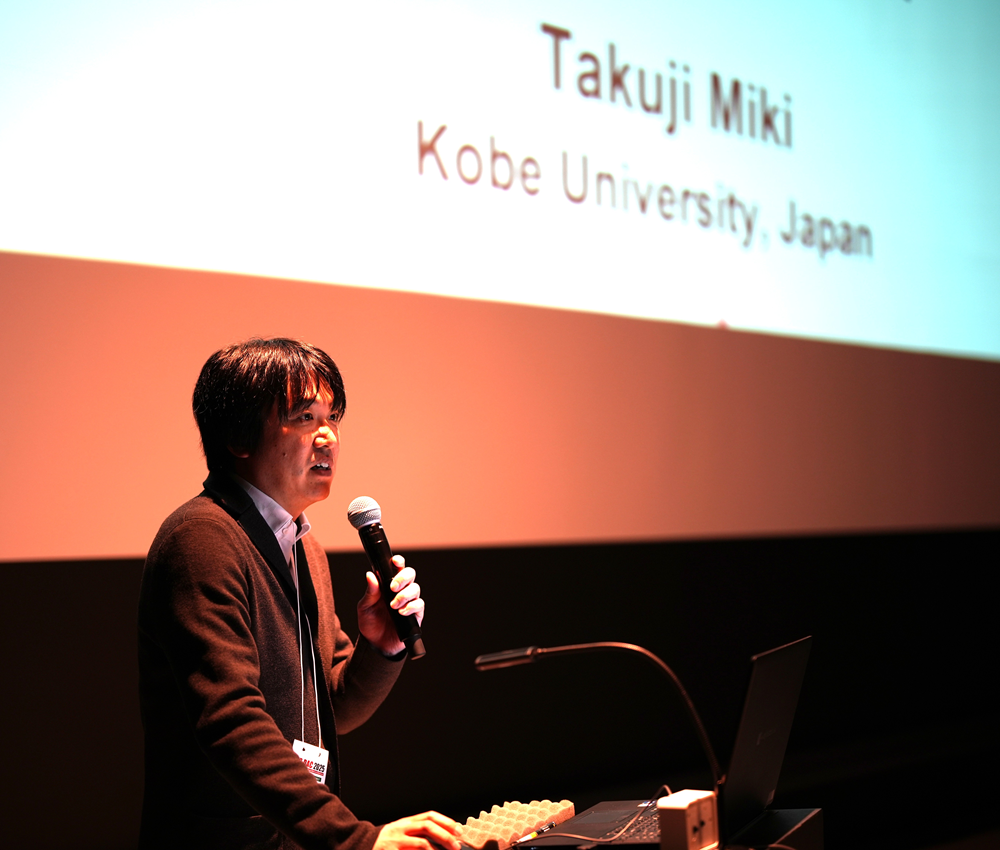
We also need to think about a future where quantum computing has been achieved. Quantum computers are expected to have important applications in fields such as drug discovery and biotechnology. Research in engineering biology is thriving at Kobe University, and Kobe City has its KOBE Biomedical Innovation Cluster, where medical manufacturers have gathered together, so we’d like to create a system that takes advantage of those strengths. Actually, we’re attempting to build a framework for interdisciplinary co-creation at Kobe University that brings together quantum technology with medicine and biotechnology.
Computers used to be big enough to take up an entire room, but eventually, each person was able to have their own computer, and now they’re as small as smart phones. I believe quantum computers will also be utilized in various situations in society and greatly change how we live. Quantum technology is sure to affect the lives of each and every individual in the generations to come, so I also want researchers and students from other fields to learn more about it. To that end, I hope to contribute to raising awareness about quantum technology.
Resume
From 2006-2017, worked at Panasonic Corporation. In 2017, completed the doctoral program at the Graduate School of System Informatics, Kobe University and received his doctorate in engineering. In 2017, became project associate professor, in 2022, became associate professor, and in 2025, became professor at the Graduate School of Science, Technology and Innovation, Kobe University. Also in 2025, became distinguished professor at the Kobe University Institute for Advanced Research.