

Unveiling cosmic dark matter through international collaboration
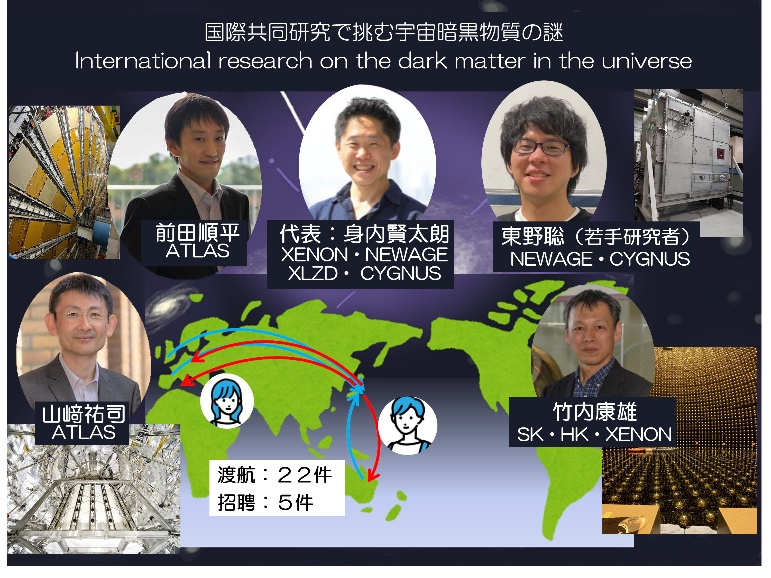
Dark matter, which accounts for approximately 80% of the universe’s mass-energy content, remains one of the greatest unsolved mysteries in modern physics. We address this challenge through active participation in major international research projects, including XENON, ATLAS, CYGNUS and XLZD.
The XENON experiment employs a large-scale liquid xenon detector to observe faint light and charge signals generated by interactions between dark matter particles and xenon nuclei. In contrast, the ATLAS experiment seeks to produce dark matter particles through high-energy particle collisions at a giant particle accelerator. As key members of these international collaborations, our primary contribution lies in upgrading detectors and enhancing their performance.
In addition, we are leading contributors to the CYGNUS experiment, which focuses on identifying the directional origin of dark matter. Within this framework, Kobe University spearheads the NEWAGE project, utilizing a gaseous micro-pattern time projection chamber (μ-TPC) to record the three-dimensional trajectories of dark matter-induced events.
This project aims to significantly strengthen Kobe University’s presence in the global dark matter research community by dispatching young researchers and graduate students to international research sites. Beyond personnel exchange, we actively promote international networking and the broad dissemination of research outcomes. One tangible outcome of our efforts was the international workshop CYGNUS 2026, which was attended by 51 individuals, 27 of whom were from overseas.
Project period
2025.04.01 ~ 2028.03.31
SDGs

SHARE