

Bioengineered E. coli bacteria can now produce a group of compounds with anticancer, anti-HIV, antidiabetic and anti-inflammatory activities. The Kobe University achievement is the result of a rational design strategy that yields a platform for the industrial production of drug candidates.
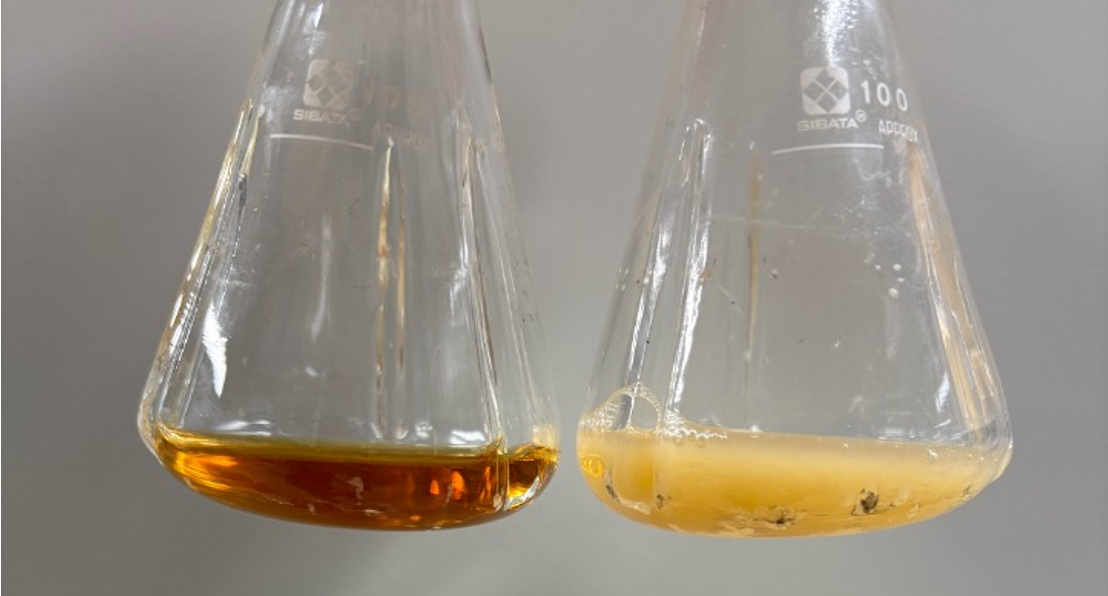
Plants produce many substances with promising pharmacological activities, but their industrial production is unreliable and expensive. Kobe University bioengineer HASUNUMA Tomohisa and his team have now succeeded in producing the core compound of a group of anticancer, anti-HIV, antidiabetic and anti-inflammatory pharmaceuticals in the gut bacterium E. coli at high yields. The flasks contain cultures of engineered bacteria before (left) and after (right) cultivation. © TOMITA Itsuki (CC BY)
Plants produce many substances with promising pharmacological activities. For example, Rhododendron species produce a class of compounds, called orsellinic acid-derived meroterpenoids, with remarkable anticancer, anti-HIV, antidiabetic and anti-inflammatory activities. However, despite their attractiveness for pharmacological research, their natural origin makes them unreliable and expensive to produce and previous attempts at the microbial production of the core compound, orsellinic acid, have only reached disappointingly low yields. Kobe University doctoral student TOMITA Itsuki says: “There are many examples where compounds appear promising in the literature but fail to advance sufficiently in evaluation or applied research due to supply issues. I began to feel this is less an issue with individual compounds and more a structural challenge facing natural products research as a whole.”
Tomita works in the group of Kobe University bioengineer HASUNUMA Tomohisa, a team of experts in rationally designing microorganisms, such as the gut bacterium Escherichia coli, for the production of a broad range of compounds. Using a combination of introducing appropriate genes from plants, fungi and bacteria, analyzing the organism’s metabolism and optimizing the culture conditions, they set out to create the first production platform for these compounds ready for industrial-scale production based on the widely used bacterium E. coli.
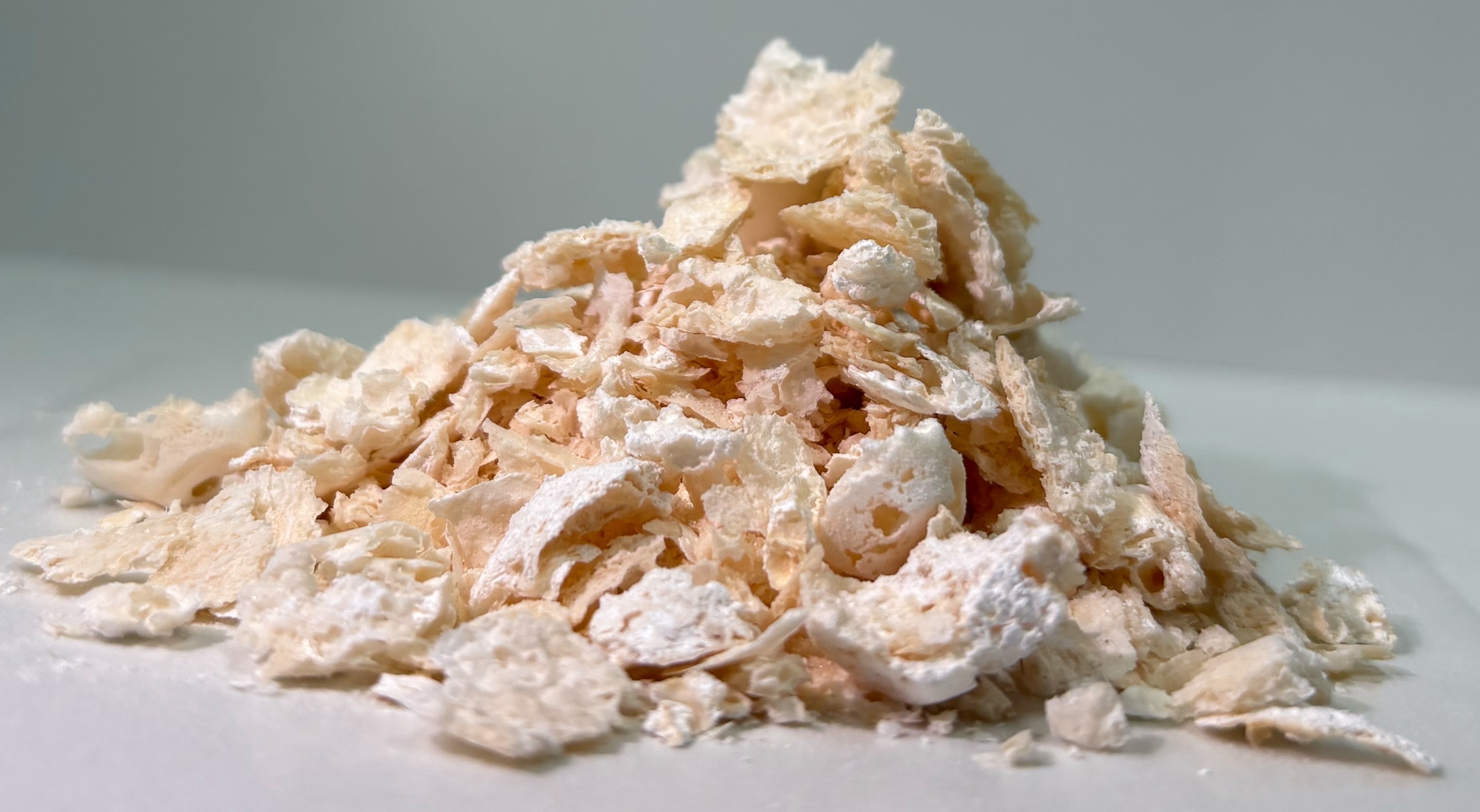
In the journal Metabolic Engineering, the Kobe University bioengineers now publish that they achieved a production of 202 mg orsellinic acid per liter, which represents a 40-fold improvement over the previously reported microbial production. This was not only the highest production level achieved so far, it was also the first time the core compound was produced in E. coli. Tomita, who is the study’s first author, says, “It is a significant achievement that we recreated a complex eukaryotic biosynthetic pathway in the bacterium E. coli, something that was previously thought difficult.”
In addition, the group also introduced a further gene from Rhododendron that completed the biosynthesis of a pharmacologically relevant compound. As a representative for the class of pharmaceuticals, the Kobe University team chose grifolic acid, a compound known for its potent anticancer and analgesic properties. And while the so-engineered bacteria could successfully produce the target compound, the yield was low and Hasunuma’s team acknowledges the need to further optimize the production process. In fact, they have already identified potential bottlenecks to be optimized in future studies.
But the group’s aims go far beyond this. Hasunuma explains: “In the short term, the platform established in this study can be immediately applied to the production and evaluation of related compounds and their derivatives. However, the rational design strategy employed here serves as a foundational technology for the production of various complex compounds using E. coli.”
Acknowledgements
This research was funded by the Japan Society for the Promotion of Science (Program for Forming Japan’s Peak Research Universities (J-PEAKS)) and the Japan Science and Technology Agency (grant JPMJGX23B4). It was conducted in collaboration with researchers from the University of Minho and the RIKEN Center for Sustainable Resource Science.
Original publication
I. Tomita et al.: Biosynthetic platform for orsellinic acid-derived meroterpenoids in Escherichia coli. Metabolic Engineering (2026). DOI: https://doi.org/10.1016/j.ymben.2025.12.008
Release on EurekAlert!
Rhododendron-derived drugs now made by bacteria
Inquiries
For inquiries, please contact gnrl-intl-press[@]office.kobe-u.ac.jp