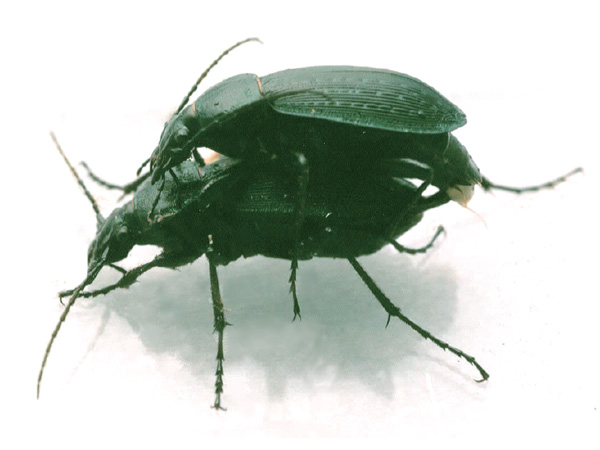


The evolutionary paths that created snatching forelimbs in insects multiple times moved in a similar direction but didn’t end up at a single solution. The Kobe University research is a pioneering study of how organs with similar functions evolve, providing a new analytical approach to identify evolutionary dynamics quantitatively.
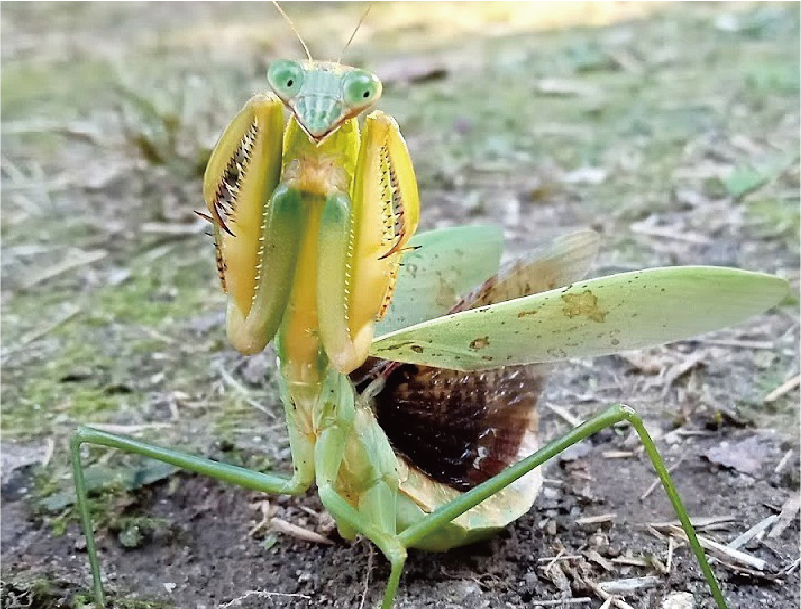
“When we discover that the incredibly functional forms and behaviors of living organisms have emerged repeatedly over time, we naturally wonder why,” says Kobe University evolutionary biologist TAKAMI Yasuoki. One often-cited example for such “convergent evolution” is that animals hunting under water have very similar shapes even though they evolve from very different backgrounds, as seen in sharks, dolphins and extinct ichthyosaurs. Another striking example is snatching forelimbs in insects, which have evolved at least seven times independently and among these in the praying mantis. Takami says, “However, no one has studied this across insect lineages.” So, while the “raptorial forelimbs,” as they are called, might look similar, it is unclear whether it is actually convergent evolution.
To address the question, Takami had to develop a new approach. He explains: “Detailed anatomical studies on the repeated evolution of raptorial forelimbs of course exist. But, maybe because the more familiar people get with insect anatomy, the less they are able to ignore details, no attempts have been made at quantifying the process across lineages.” He and his team constructed a framework that allows researchers to statistically tell apart the different ways evolution can shape a group of organisms: shift in mean shape, reduced shape variation and similar evolutionary directions. They then conducted their analysis based on the length of various limb and body parts, deliberately ignoring all other detailed structural features, by plotting the shifts in measures between species without snatching forelimbs and those with on a multi-dimensional map of the “morphospace,” the space of all possible shape configurations.
In the journal Scientific Reports, the Kobe University team now reports that they actually did not find evidence for convergent evolution, at least as expressed by the body parts’ relative lengths. Takami says, “It seems paradoxical, but while the snatching forelimbs have evolved repeatedly, they are not actually similar.” The forelegs and forebody, in particular, have evolved in similar directions across the lineages, especially if aquatic ones are excluded, but the essential point is that they haven’t settled on a specific final shape. This means that there are different shapes that capture the same ecological function.
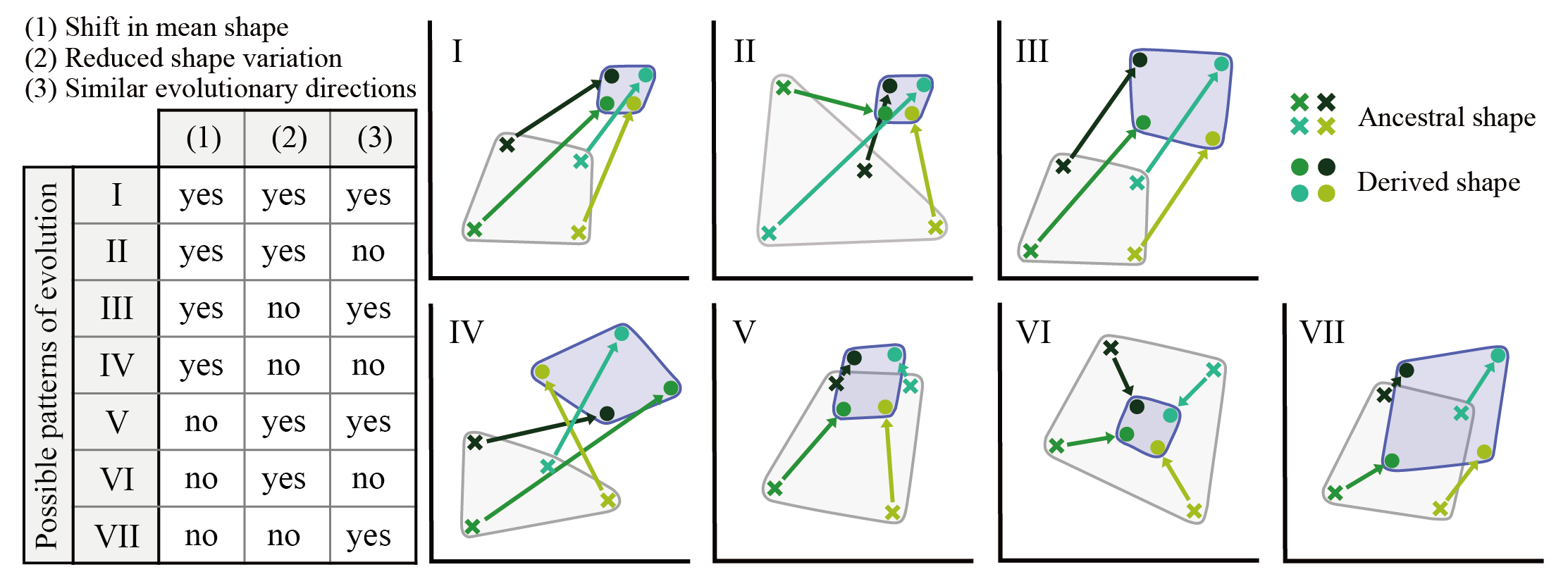
However, there was one more fascinating detail in the data. Together with the evolution of snatching forelimbs, the insects’ heads became wider and their “necks” longer, to an extent that comes very close to an overall shift in mean shape in addition to a similar direction of evolution. “The evolution of a broader head is thought to have led to better stereoscopic vision, making it easier to judge the distance to prey. This suggests that there is a strong natural selection and little room for shape variation when it comes to visual perception,” explains Takami.
“This work marks the conclusion of our research into the phenomenon of the repeated evolution of snatching appendages,” says Takami. Still, the work might have more far-reaching implications. He explains, “We believe that the conceptual framework and analytical methods used in this study to analyze repeated evolution will be very useful for future similar research.”
Acknowledgements
This research was partly funded by the Japan Society for the Promotion of Science (grant 16H04844). It was conducted in collaboration with researchers from the Hyogo Prefectural Institute of Technology.
Original publication
H. Miyaji et al.: Quantifying the repeated evolution of insect raptorial forelegs. Scientific Reports (2026). DOI: 10.1038/s41598-026-57616-w
Release on EurekAlert!
Many ways to become a monster and one map to tell
Inquiries
For inquiries, please contact gnrl-intl-press[@]office.kobe-u.ac.jp