

When one person helps, or refuses to help, another in public, this may change not only the provider’s reputation but also the recipient’s. A theoretical study led by Kobe University provides the simplest explanation for how cooperation in large communities becomes stable and provides insights into phenomena like the bystander effect.

In pairwise relationships, it is easy to keep track of the other person’s reputation and interact accordingly, but larger groups cause evaluations to diverge, making it difficult for cooperation to remain stable in theoretical models. Kobe University social psychologist THAM Yukari Jessica and her team constructed a model that allows observers of an interaction to update their views on both the donor and the receiver and explored whether this leads to norms that enable socially stable cooperation. © Kobe University (CC BY)
A society is built on our ability to cooperate, but why did we even begin to cooperate in the first place? As Kobe University social psychologist THAM Yukari Jessica explains: “Cooperation seems so natural in everyday life, but from an evolutionary perspective, it is actually puzzling why individuals should bear costs to help others, and that fundamental question has stayed with me ever since I was a graduate student.” Researchers across the social sciences are trying to identify the rules and norms that allow cooperation to emerge as a stable social feature. In pairwise relationships, it is easy to keep track of the other person’s reputation, which then tells us how to interact with that person. As soon as groups get larger, however, people’s evaluations of others start to diverge. Such disagreements in reputation make it difficult for cooperation to remain stable in theoretical models. To explain how cooperation can nevertheless be maintained, researchers have incorporated additional mechanisms into their models, such as gossip and public institutions. “These mechanisms can help people align their views of others, but they require additional information sharing or coordination,” adds Tham.
She and her collaborators from RIKEN and the Interdisciplinary Transformation University took a simpler approach. In standard models of cooperation, observers update their opinion of the person who decides whether to help—the donor—but not of the person on the receiving end. The researchers asked what would happen if observers used the very same interaction to update their opinion of the recipient as well. “If Alice sees Bob help Charlie, she may infer that Charlie is someone worthy of being helped, or at least that Bob considers Charlie worthy of help. In this way, people may gain information about how others view a person simply by observing how that person is treated, without any additional information sharing,” Tham explains. So, they constructed a model that allows observers of an interaction to update their views on both the donor and the receiver, and explored whether this leads to norms, which are rules that tell people how to treat people with a certain reputation and how to evaluate their actions, that enable socially stable cooperation.
In the journal PNAS, they now report that this seemingly small change can have a major effect: allowing observers to update the recipient’s reputation helps people’s evaluations become more aligned, which in turn makes cooperation easier to sustain. Moreover, one social norm for judging recipients, which they called “recipient image scoring” (RIS), was particularly effective. “The rule is simple: if someone receives help, observers evaluate that person as good; if they do not receive help, observers evaluate them as bad,” Tham explains. “In this way, people adjust their own evaluation of someone based on how others treat that person. This helps prevent disagreements in reputation from spreading and thereby supports cooperation.”
Using the supercomputer Fugaku, which is located in Kobe and was the fastest supercomputer in the world when it started regular operation in 2021, the team also tested a space of over a million different combinations of norms to see how evolutionarily stable and how cooperative societies are that adopt them. Tham says, “We found 61 norms that lead to high cooperation as well as evolutionary stability and all of these included some form of dual reputation update. This suggests that evaluating the recipient may be a much more general ingredient for stable cooperation than previously recognized.”
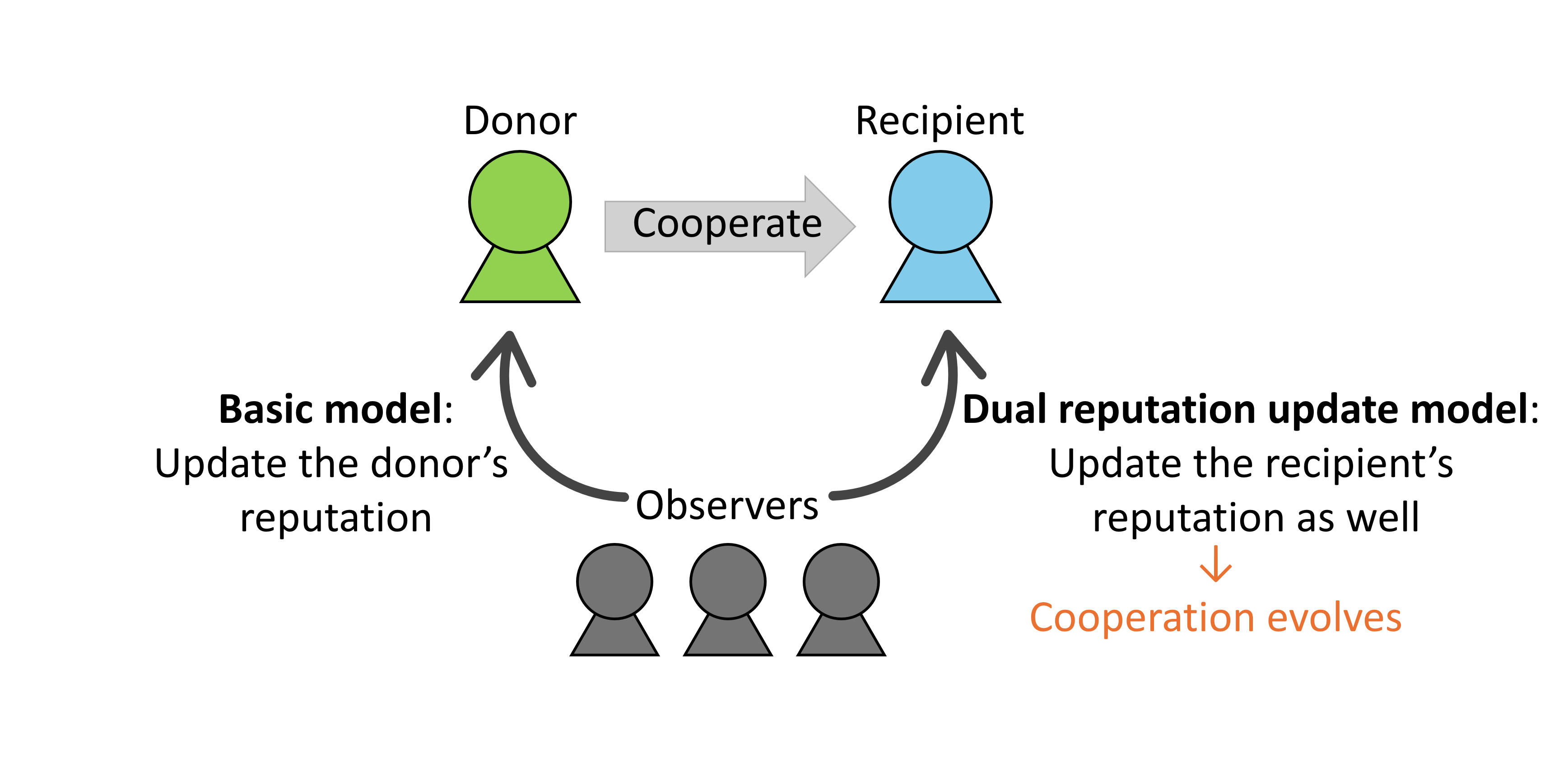
Tham and her collaborators from RIKEN and the Interdisciplinary Transformation University found that a simple extension of conventional reputation models can have a major effect: allowing observers to update not only the donor’s reputation but also the recipient’s can reduce disagreements in reputation and make cooperation easier to sustain. @THAM Yukari Jessica (CC BY)
Tham and her team show that opinion synchronization can occur using a simple mechanism, but it doesn’t mean that any of the other mechanisms that researchers have proposed, such as gossip or public institutions, are obsolete. “We believe that these different mechanisms might have evolved in tandem, each contributing to the reduction of disagreements,” the authors state in the paper.
Tham comments on the outcomes of the study: “I think we often judge people not only by what they themselves do, but also by how they are treated by those around them. Our results suggest that this tendency may help coordinate reputations and thereby maintain cooperation. At the same time, the very same tendency could contribute to harmful outcomes such as exclusion or bullying if we treat someone badly simply because we see others treating them badly.” She continues: “I therefore think it is important to be aware of this tendency when we form judgments about others, although whether people actually form reputations in this way is an empirical question for future research.”
Acknowledgements
This research was funded by the Program for the Development of Next-Generation Leading Scientists with Global Insight (L-INSIGHT), sponsored by the Ministry of Education, Culture, Sports, Science and Technology (MEXT), the European Research Council Starting Grant 850529: E-DIRECT, JSPS KAKENHI (grant number JP25K07145) and the RIKEN Global Commons Project “Planetary Resilience Science for Safeguarding the Global Commons”.
Original publication
Y. J. Tham et al.: Indirect reciprocity with dual private assessment. Proceedings of the National Academy of Sciences of the United States of America (2026). DOI: 10.1073/pnas.2624656123
Release on EurekAlert!
Your reputation depends on how others treat you
Inquiries
For inquiries, please contact gnrl-intl-press[@]office.kobe-u.ac.jp