

Event date: 2026.06.22
Audience Business and community Alums Students Professors and staff
Location Rokkodai 2nd Campus
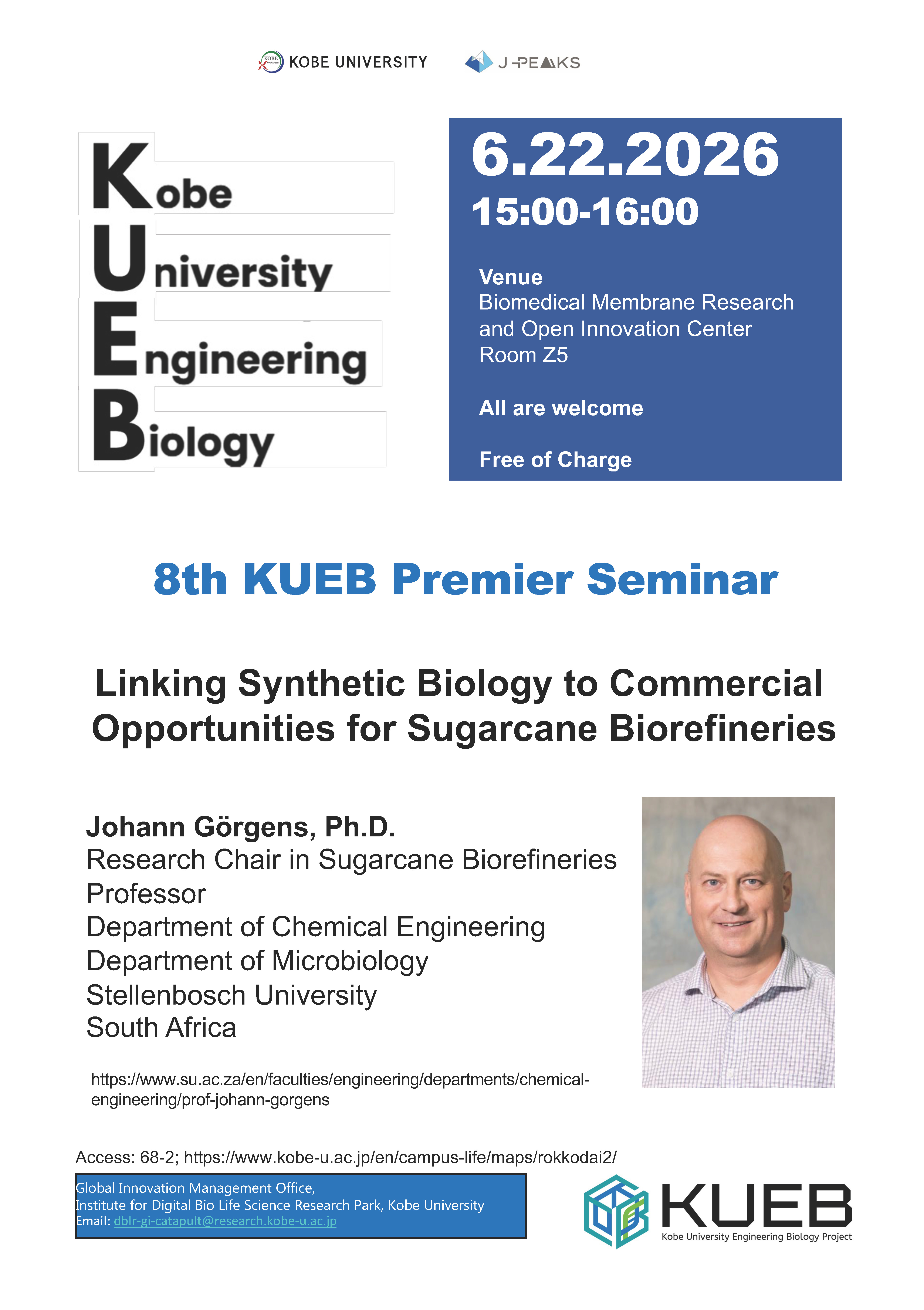
We are pleased to announce that Professor Johann Görgens, Stellenbosch University, South Africa, will deliver a research seminar.
Seminar Details
- Date: 15:00-16:00, June 22, 2026
- Location: Room Z5, Biomedical Membrane Research and Open Innovation Center, Kobe University(The venue is located on the second floor of Building 68-2 indicated in the link.)
- Speaker: Professor Johann Görgens, Stellenbosch University, South Africa
- Title: Linking Synthetic Biology to Commercial Opportunities for Sugarcane Biorefineries
- Language: English
- Admission: Free of charge
- All are welcome; no prior registration is required.
- Organizer: Advanced Research Hub for Engineering Biology, Institute for Digital Bio Life Science Research Park, Kobe University
- Contact: Research Management Division, Department of Academic Research and Co-Creative Innovation Administration, Kobe University
ksui-dblr[at]office.kobe-u.ac.jp (Please replace [at] with @ when sending an email.)
Abstract
This work presents an integrated framework for prioritising and developing commercially viable sugarcane biorefinery pathways, spanning benchmarking, technology development and pilot-scale validation. More than forty sugar-derived products were evaluated using Aspen Plus® simulations, techno-economic assessment (TEA), and life cycle assessment (LCA), enabling identification of high-potential pathways based on economic and greenhouse gas (GHG) performances. While many biofuels and bioplastics remain cost-challenged, selected food-related and specialty chemicals show strong potential for diversification.
Synthetic biology is positioned as a key enabler to realise these opportunities. Modelling of bioprocess performance demonstrated how improvements in yield, productivity, and titre can drive economic viability for target molecules such as 3-hydroxypropionic acid (3-HP) and 2,3-butanediol (2,3-BDO), providing a quantitative basis for prioritising R&D investment. Complementary strain engineering work established a novel oxaloacetate pathway for 3-HP production in Komagataella pastoris, achieving titres up to 50.6 g/L and demonstrating the feasibility of efficient sugar-based bioprocesses in non-conventional yeast hosts.
These capabilities are integrated through a 1000 L containerised demoplant, to demonstrate pilot-scale process performances of advanced microbes under the conditions of industrial operations and feedstock variations in the sugarcane industry, as exemplified by a current project on cellulosic ethanol production. The platform enables translation from modelling and laboratory development to pilot-scale validation across multiple feedstocks and products. Collectively, this end-to-end approach provides a robust pathway to identify priorities for the application of synthetic biology to the development of new microbial bioprocesses, and accelerating the commercialisation of these in diversified sugarcane biorefineries.
(Global Innovation Management Office, Institute for Digital Bio Life Science Research Park)
(Incharge:DBLR (Digital Bio Life Science Research Park) Promotion Office, Department for Research Management and External Cooperation)