

Event date: 2026.07.03
Audience Business and community Alums Students Professors and staff
Location Rokkodai 2nd Campus
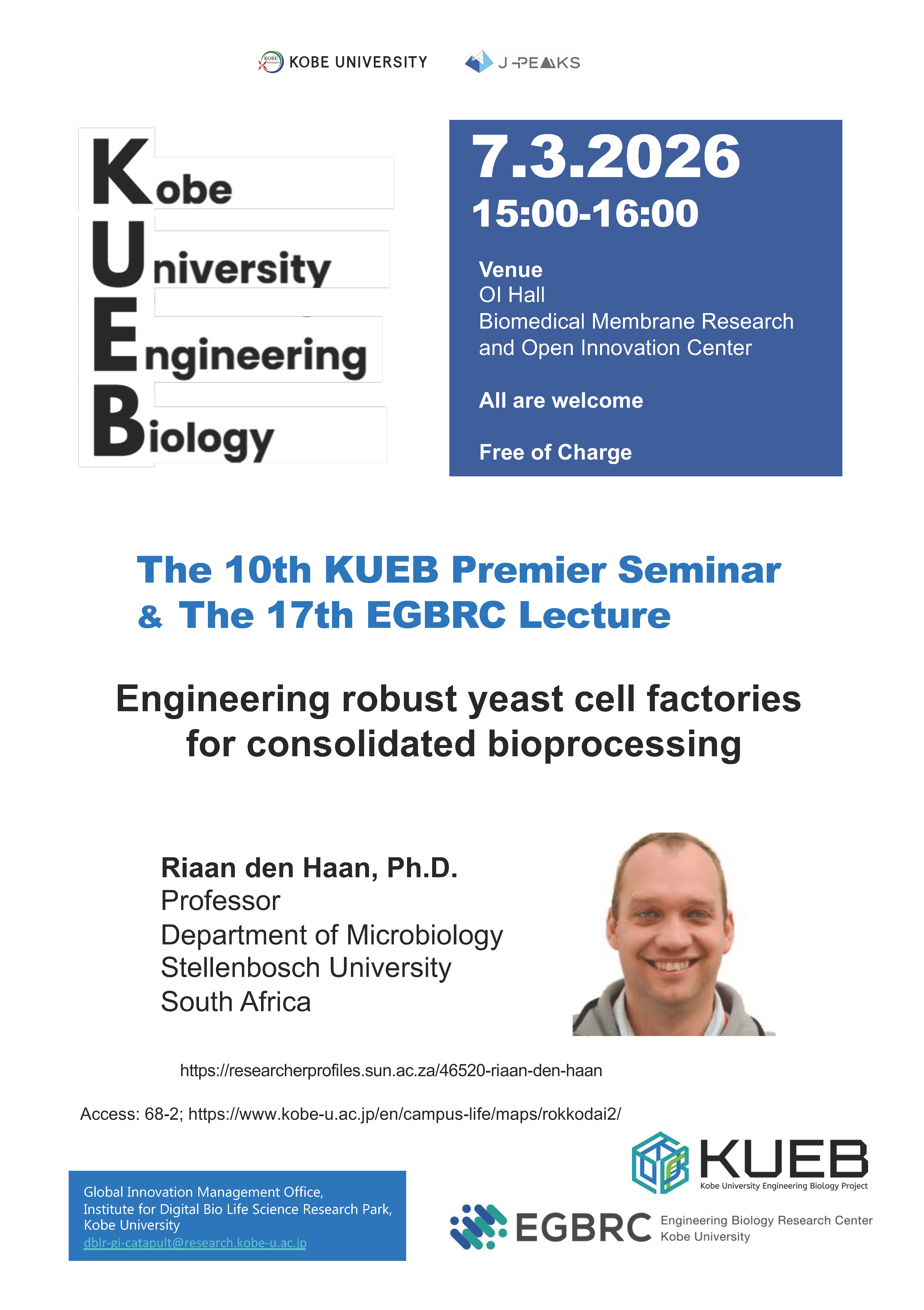
We are pleased to announce that Professor Riaan den Haan, Stellenbosch University, South Africa, will deliver a research seminar.
Seminar Details
- Date: 15:00-16:00, July 3, 2026
- Location: Daicel OI Hall, Biomedical Membrane Research and Open Innovation Center, Kobe University
- Speaker: Professor Riaan den Haan, Stellenbosch University, South Africa
- Title: Engineering robust yeast cell factories for consolidated bioprocessing
- Language: English
- Admission: Free of charge
- All are welcome; no prior registration is required.
- Organizer: Advanced Research Hub for Engineering Biology, Institute for Digital Bio Life Science Research Park, Kobe University
- Co-organizer: Engineering Biology Research Center
- Contact: Research Management Division, Department of Academic Research and Co-Creative Innovation Administration, Kobe University
ksui-dblr[at]office.kobe-u.ac.jp (Please replace [at] with @ when sending an email.)
Abstract
The sustainable production of second-generation bioethanol from lignocellulosic biomass (LCB) requires microbial platforms capable of efficient sugar utilisation, high-level enzyme production, and resilience under industrial conditions.
This work presents an integrated approach to engineering Saccharomyces cerevisiae as a robust chassis for consolidated bioprocessing (CBP), enabling the direct conversion of complex biomass into ethanol.
We demonstrate that careful optimisation of gene expression systems—particularly promoter selection tailored to environmental and protein-specific contexts—can significantly enhance heterologous enzyme production and CBP performance.
Building on this, natural yeast isolates were developed as superior industrial hosts through the introduction of xylose utilisation pathways, transporter systems, and adaptive laboratory evolution, resulting in strains capable of efficient co-utilisation of xylose and xylan with among the highest reported ethanol titres from polymeric substrates.
Further improvements in biomass conversion were achieved through strategic design of enzyme expression systems, where cell‑tethered cellulase configurations outperformed free enzyme systems in both hydrolytic efficiency and fermentation performance. These designs also conferred enhanced cellular robustness under process‑relevant stresses, highlighting the importance of expression architecture in strain engineering.
Finally, addressing a key industrial bottleneck, we explored green‑synthesised silver nanoparticles as an alternative to antibiotics for controlling bacterial contamination during fermentation. These nanoparticles selectively inhibited lactic acid bacteria while maintaining yeast performance, leading to improved ethanol yields in non‑sterile processes.
Collectively, this work advances the development of industrial yeast strains that integrate efficient substrate utilisation, high enzyme productivity, and process robustness, bringing the realisation of economically viable CBP for lignocellulosic bioethanol production closer to reality.
(Global Innovation Management Office, Institute for Digital Bio Life Science Research Park)
(Incharge:DBLR (Digital Bio Life Science Research Park) Promotion Office, Department for Research Management and External Cooperation)