

開催日: 2026.07.03
開催場所 六甲台第2キャンパス
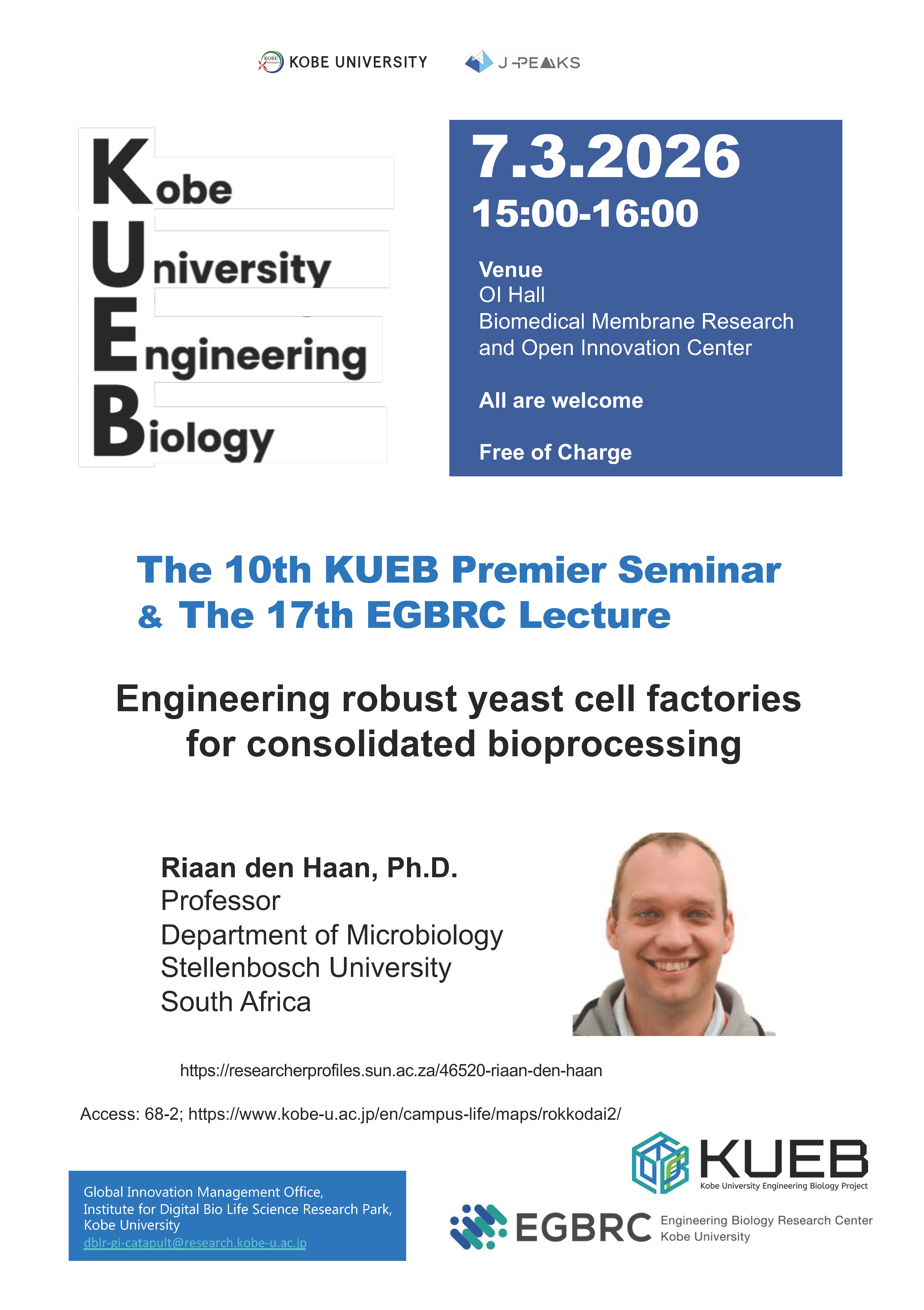
Riaan den Haan教授(南アフリカ・Stellenbosch University)をお招きし、「Engineering robust yeast cell factories for consolidated bioprocessing」と題して、10th KUEB Premier Seminarにてご講演いただきます。
酵母を用いて、バイオマスから効率的にバイオエタノールを生産することに関する研究を発表されます。
ぜひ、ご参加ください。
開催概要
- 日 時:2026年7月3日(金) 15:00〜16:00
- 会 場:BMO棟ダイセルOIホール
- 講演者:Riaan den Haan, Ph.D.
- 講演タイトル:Engineering robust yeast cell factories for consolidated bioprocessing
- 開催言語:英語
- 参加費:無料
- 参加対象:どなたでもご参加いただけます(事前登録不要)
- 主 催:神戸大学 デジタルバイオ・ライフサイエンスリサーチパーク推進機構 バイオものづくり共創研究拠点
- 共 催:神戸大学 先端バイオ工学研究センター
- 問合せ先:研究推進課DBLR推進グループ ksui-dblr[at]office.kobe-u.ac.jp ※メールアドレスは[at]を@に変更して下さい
講演要旨
The sustainable production of second-generation bioethanol from lignocellulosic biomass (LCB) requires microbial platforms capable of efficient sugar utilisation, high-level enzyme production, and resilience under industrial conditions.
This work presents an integrated approach to engineering Saccharomyces cerevisiae as a robust chassis for consolidated bioprocessing (CBP), enabling the direct conversion of complex biomass into ethanol.
We demonstrate that careful optimisation of gene expression systems—particularly promoter selection tailored to environmental and protein-specific contexts—can significantly enhance heterologous enzyme production and CBP performance.
Building on this, natural yeast isolates were developed as superior industrial hosts through the introduction of xylose utilisation pathways, transporter systems, and adaptive laboratory evolution, resulting in strains capable of efficient co-utilisation of xylose and xylan with among the highest reported ethanol titres from polymeric substrates.
Further improvements in biomass conversion were achieved through strategic design of enzyme expression systems, where cell‑tethered cellulase configurations outperformed free enzyme systems in both hydrolytic efficiency and fermentation performance. These designs also conferred enhanced cellular robustness under process‑relevant stresses, highlighting the importance of expression architecture in strain engineering.
Finally, addressing a key industrial bottleneck, we explored green‑synthesised silver nanoparticles as an alternative to antibiotics for controlling bacterial contamination during fermentation. These nanoparticles selectively inhibited lactic acid bacteria while maintaining yeast performance, leading to improved ethanol yields in non‑sterile processes.
Collectively, this work advances the development of industrial yeast strains that integrate efficient substrate utilisation, high enzyme productivity, and process robustness, bringing the realisation of economically viable CBP for lignocellulosic bioethanol production closer to reality.
(DBLR推進機構GI推進室)
(担当:研究推進課)