

開催日: 2026.06.22
開催場所 六甲台第2キャンパス
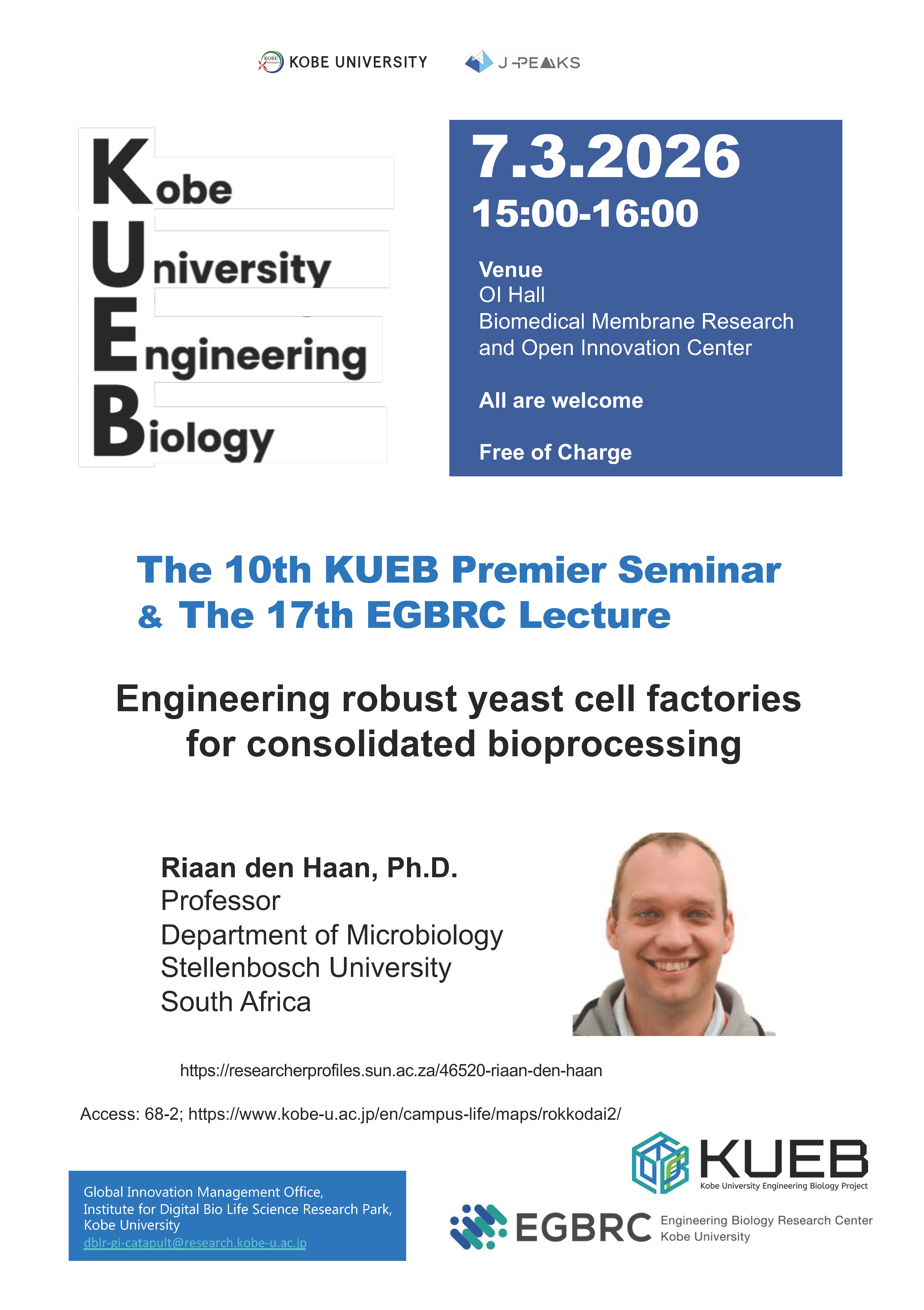
Johann Görgens教授(南アフリカ・Stellenbosch University)をお招きし、「Linking Synthetic Biology to Commercial Opportunities for Sugarcane Biorefineries」と題して、8th KUEB Premier Seminarにてご講演いただきます。
ケミカルエンジニアリングとLCAの専門家が、サトウキビを題材に、LCAを駆使した合成生物学によって商業化を加速することについて講演します。
ぜひご参加ください。
開催概要
- 日 時:2026年6月22日(月) 15:00〜16:00
- 会 場:神戸大学BMO棟 2F Meeting room Z5(リンク先[68-2]の建物の2Fです。)
- 講演者:Johann Görgens, Ph.D.
- 講演タイトル:Linking Synthetic Biology to Commercial Opportunities for Sugarcane Biorefineries
- 開催言語:英語
- 参加費:無料
- 参加対象:どなたでもご参加いただけます(事前登録不要)
- 主 催:神戸大学 デジタルバイオ・ライフサイエンスリサーチパーク推進機構 バイオものづくり共創研究拠点
- 共 催:神戸大学 先端バイオ工学研究センター
- 問合せ先:研究推進課DBLR推進グループ ksui-dblr[at]office.kobe-u.ac.jp ※メールアドレスは[at]を@に変更して下さい
講演要旨
This work presents an integrated framework for prioritising and developing commercially viable sugarcane biorefinery pathways, spanning benchmarking, technology development and pilot-scale validation. More than forty sugar-derived products were evaluated using Aspen Plus® simulations, techno-economic assessment (TEA), and life cycle assessment (LCA), enabling identification of high-potential pathways based on economic and greenhouse gas (GHG) performances. While many biofuels and bioplastics remain cost-challenged, selected food-related and specialty chemicals show strong potential for diversification.
Synthetic biology is positioned as a key enabler to realise these opportunities. Modelling of bioprocess performance demonstrated how improvements in yield, productivity, and titre can drive economic viability for target molecules such as 3-hydroxypropionic acid (3-HP) and 2,3-butanediol (2,3-BDO), providing a quantitative basis for prioritising R&D investment. Complementary strain engineering work established a novel oxaloacetate pathway for 3-HP production in Komagataella pastoris, achieving titres up to 50.6 g/L and demonstrating the feasibility of efficient sugar-based bioprocesses in non-conventional yeast hosts.
These capabilities are integrated through a 1000 L containerised demoplant, to demonstrate pilot-scale process performances of advanced microbes under the conditions of industrial operations and feedstock variations in the sugarcane industry, as exemplified by a current project on cellulosic ethanol production. The platform enables translation from modelling and laboratory development to pilot-scale validation across multiple feedstocks and products. Collectively, this end-to-end approach provides a robust pathway to identify priorities for the application of synthetic biology to the development of new microbial bioprocesses, and accelerating the commercialisation of these in diversified sugarcane biorefineries.
(DBLR推進機構GI推進室)
(担当:研究推進課)