

Understanding how proteins interact with their own mirror images enabled a Kobe University research team to design a small mirror protein that disables a causal factor of Alzheimer’s disease, amyloid-beta.

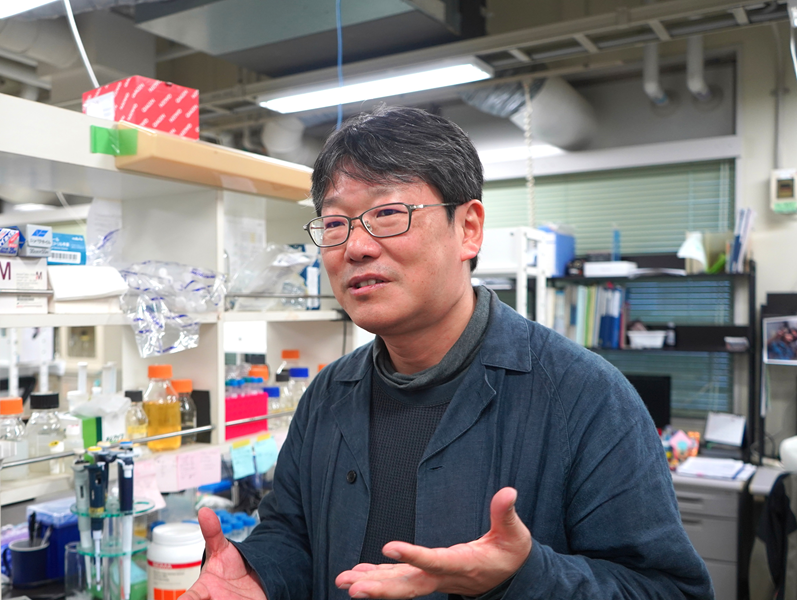
Alzheimer’s is formed by proteins in brain cells that have lost their natural shape and have become “disordered.” The main protein involved in this is called amyloid-beta. It is thought that such disordered proteins attach to other proteins, causing them to become disordered themselves, and together, they form plaques that inhibit the function of brain cells. Kobe University biochemical engineer MARUYAMA Tatsuo explains what makes targeting these proteins so difficult, saying: “There is a gap in how we approach proteins without a fixed structure. Many existing drug design strategies rely on well-defined structures, and we were frustrated by how limited they are when facing more flexible, complex biological targets, such as amyloid-beta.”
The key idea in how to approach this challenge came from materials science. Maruyama says, “It occurred to us that we could intercept amyloid-beta proteins by capturing them with small fragments of their mirror images and thus might be able to stop the aggregation of amyloid-beta proteins.” Proteins, as well as their individual components called “amino acids,” can in theory occur in two forms that are mirror images to each other like the left and right hand, but in nature they are predominantly composed of only one form. It has been known that short chains of “left-handed” and artificially created “right-handed” amino acids can interact and form stable structures, but a rational design exploiting this mechanism has been absent.
In the scientific journal Chemistry — A European Journal, Maruyama and his team now present a systematic study of small model proteins to find out which molecular mechanisms are important for “left-handed” and “right-handed” proteins to bind to each other efficiently. The Kobe University group then used this new-found understanding to design a short “right-handed” amino acid chain that can efficiently bind to the Alzheimer’s-causing amyloid-beta protein and under the tested conditions inhibited the protein better than a different currently promising drug candidate molecule. The interaction can be likened to a right and a left hand fitting together, making it impossible for the left arm to grab other things. “To me, the most exciting aspect of this study is that the simple and intuitive principle of mirrored molecules — a phenomenon chemists call ‘chirality’ — can be used as a design tool for molecular recognition. It connects a fundamental concept in chemistry with a very challenging problem in biology,” says Maruyama.
The group further performed tests with mouse brain cell cultures to find out how effective their protein would be under more biological conditions. First, they made sure that their “right-handed” interceptor protein did not negatively affect viability of brain cells by itself. Then, they showed that while the viability of the cells dropped to only 50% when exposed to amyloid-beta, cells that also got the interceptor protein did not show any reduced viability, proving that their approach seems to work.
Disordered proteins are also implicated in other diseases such as Parkinson’s and some cancers. “Because of their unstable nature, such proteins have been considered ‘undruggable,’” says Maruyama explaining the wider implications of his team’s findings. They thus hope that their approach speeds up drug development from trial and error to a more systematic, rational design of a new class of therapeutic molecules. Maruyama closes, saying, “This result feels like a starting point rather than an endpoint.”
Acknowledgements
This research was funded by the Nakatani Foundation for Advancement of Measuring Technologies in Biomedical Engineering (grant 2022S230), Toyota Physical and Chemical Research, Noritz Nukumori Foundation (grant RS2408), Koyanagi Zaidan, the Canon Foundation, the Suzuken Memorial Foundation, the Japan Agency for Medical Research and Development (grants 24ek0109691, 24ym0126808j0003) and the Japan Society for the Promotion of Science (grants 23H01774, 23K13610). It was conducted in collaboration with researchers from Kindai University.
Original publication
K. Morita et al.: A Chirality-Guided Molecular Recognition Strategy for Targeting Intrinsically Disordered Proteins. Chemistry — A European Journal (2026). DOI: 10.1002/chem.70889
Release on EurekAlert!
Mirror fragments intercept Alzheimer’s-causing protein
Inquiries
For inquiries, please contact gnrl-intl-press[@]office.kobe-u.ac.jp