

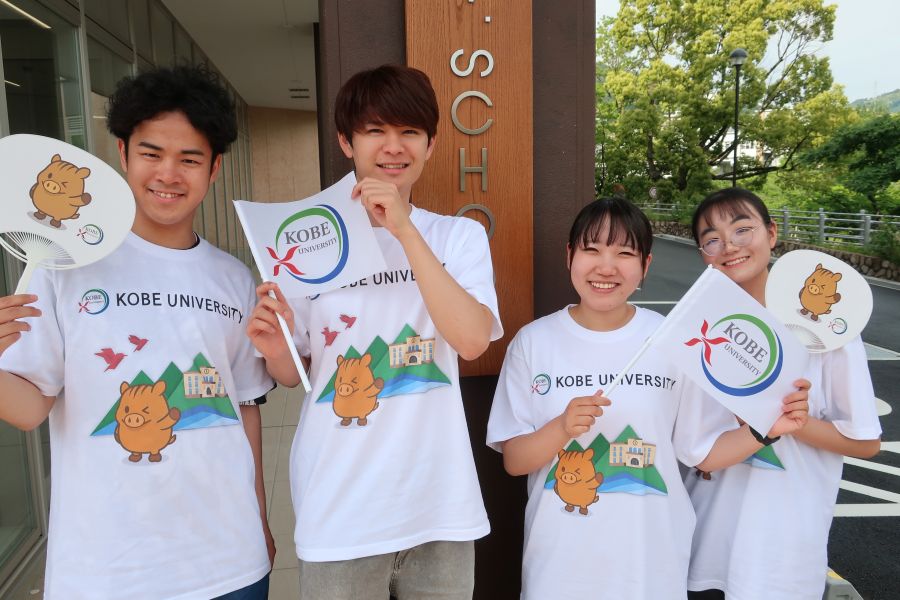
Kobe University made its first appearance at the 53rd Kobe Festival, held on May 17 at the Waterfront Area of the Former Foreign Settlement at Sannomiya. Held annually for over a half century, Kobe Festival rarely sees participation from entire universities, with zero records over the past 10 years. The eight members of the Student Planning Team of the Kobe Festival Executive Committee have been hard at work preparing over the past four months, which culminated in a 160-person procession during the festival. We sat down with four team members to hear about the emotion they poured into Kobe Festival and some behind-the-scenes stories from the day of the event.
Forging a path to the future with the city of Kobe
The beloved Kobe Festival was held for the first time in 1971 as a groundbreaking event that encouraged citizen participation to spread the appeal of Kobe far and wide. The festival arose from a merger of the “Minato no matsuri” and “Kobe Carnival,” meaning that altogether, the history of the festival spans over 90 years.

President FUJISAWA Masato proposed that the university participate in the parade, saying, “Kobe University has walked together with the city of Kobe for 124 years. I want more citizens to learn about its research and activities.” The project was planned primarily by an enthusiastic group of students who answered the passionate call to action from the president. From January of this year, the group began its preparations through close coordination with extracurricular clubs like the Cheering Squad, the art club “Ryobikai” and the Calligraphy Club.
Some 160 individuals from Kobe University participated in the festival, including President Fujisawa, university executives, faculty staff, and current students, along with junior high school students at the Kobe Center for Future Talent. The participants paraded along the 750-meter-long course for 20 minutes, cheered on by some 700,000 festival attendees. With a banner made by the Calligraphy Club at the front of the procession, the crowds were delighted to performances by the Cheering Squad, Wind Orchestra, as well as Shindai Modan Donchiki, a style of Japanese Marching Band known as chindon’ya.
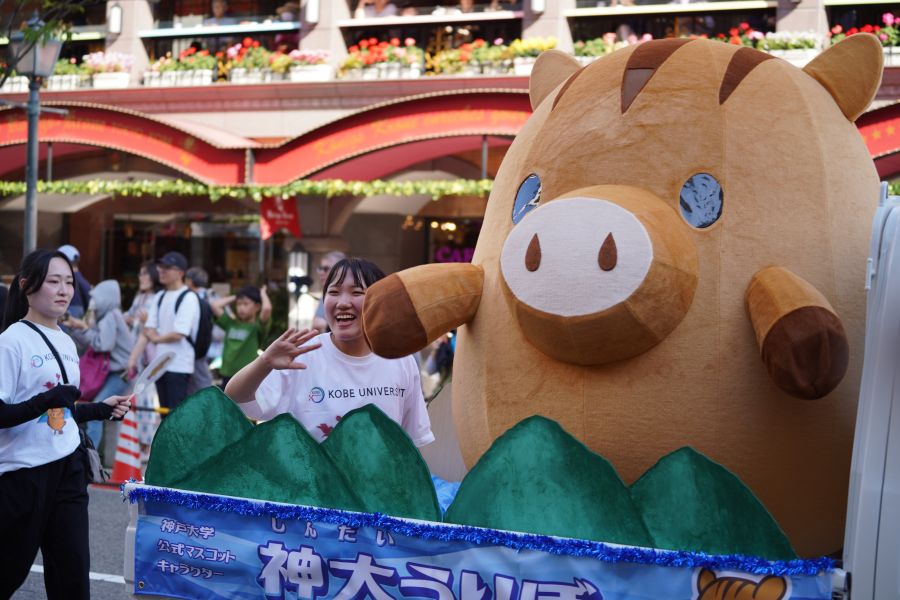
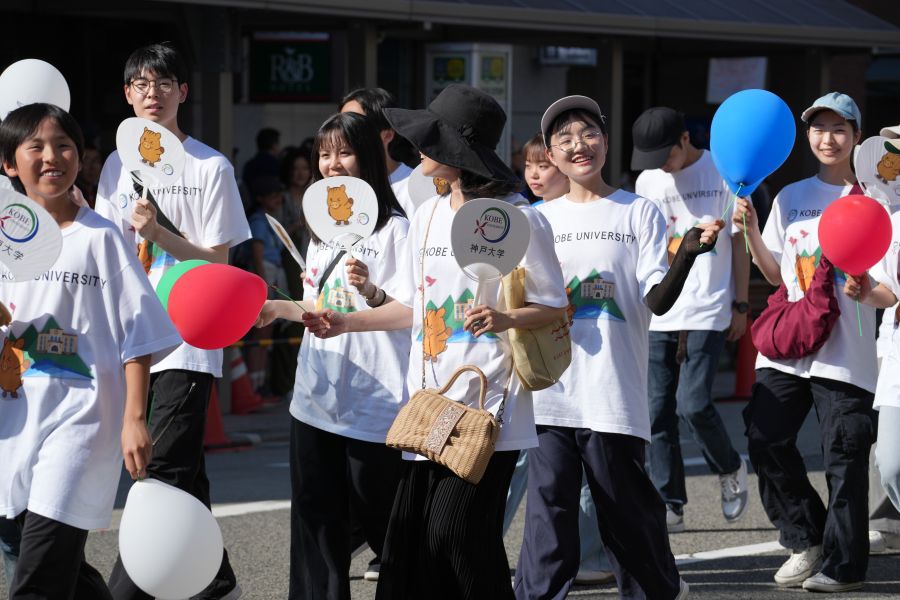
The message that the students wanted to express through the parade was “A 124 Year Voyage: Forging a path to the future with the city of Kobe.” As they discussed the concept of the parade and the story they wished to tell, they landed on the university as a “collection of knowledge” accumulated across a diverse range of fields over its 124-year-long history. Once that was decided, they injected their own emotions into the project, namely that the university’s knowledge shouldn’t be contained within it, but rather open to the city and shared among its people as it continues to evolve into the future.
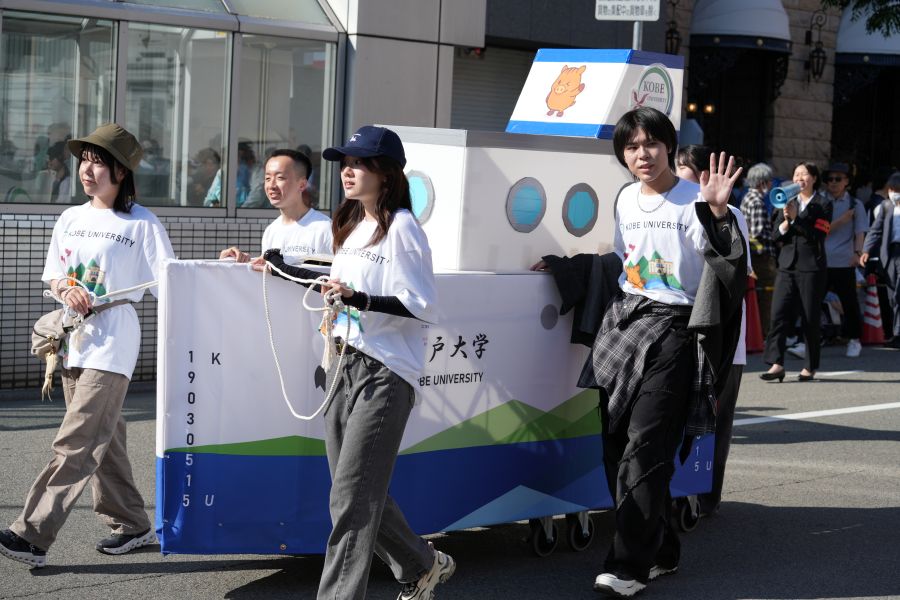
The props, banner and T-shirts were carefully designed and handmade by students with the help of the Calligraphy Club and Ryobikai. As a whole, the decorations and performance by Kobe University were designed to look like a one large ship, with the long line of participants providing a sense of cohesion and unity. The Uribo float, a small truck ridden by Kobe University’s mascot character Shindai Uribo, gathered lots of attention and was particularly popular with the kids. The ship float, which was built with two hand trucks at its base, represented the university moving forward together with Kobe City. One of many details added to the float’s design was the date of the university’s founding, 1903-05-15, written on the side.
Four months of preparation, and a concept drawn up by the student planning team
The members of Kobe University’s Value School rose to the challenge of parade direction. Their efforts were centered around fourth year Faculty of Global Human Sciences student KURIYAMA Miya, fourth year Faculty of Agriculture student KUME Shoko, fourth year School of Business Administration student AKITA Daigoro, and third year Faculty of Engineering student NAKAMURA Motomi.
The students began the nearly four-month-long planning period with a meeting with the president and held online meetings among themselves at least once a week, so information was shared among the team very frequently. On top of sending out performance requests to student groups like the Cheering Squad, the team also inspected the venue, drew up drafts of the performance, designed T-shirts and other outfits, and decorated the hand trucks for the float. They continued making props all the way up until the day before the festival, all the while doing dry runs for loading Shindai Uribo onto the small truck bed.
The Value School, to which the four students belong, was established in 2020 and is an organization open to all students that supports interdepartmental research. Under the keyword of “value,” the organization serves to coordinate among the vertically oriented academic fields to develop new value creation education while also acting as a platform to further expand various value creation research carried out in each field. Some 300 students from both undergraduate and graduate schools are registered at Value School, and since students from all undergraduate schools can register, they were singled out as the executive team for the parade performance. Professor TSURUTA Hiroki, director of Value School’s Value Creation and Development Division, says, “The four members of the group worked quite hard in this student-led effort; they even led negotiations for appearances by members of the university.”
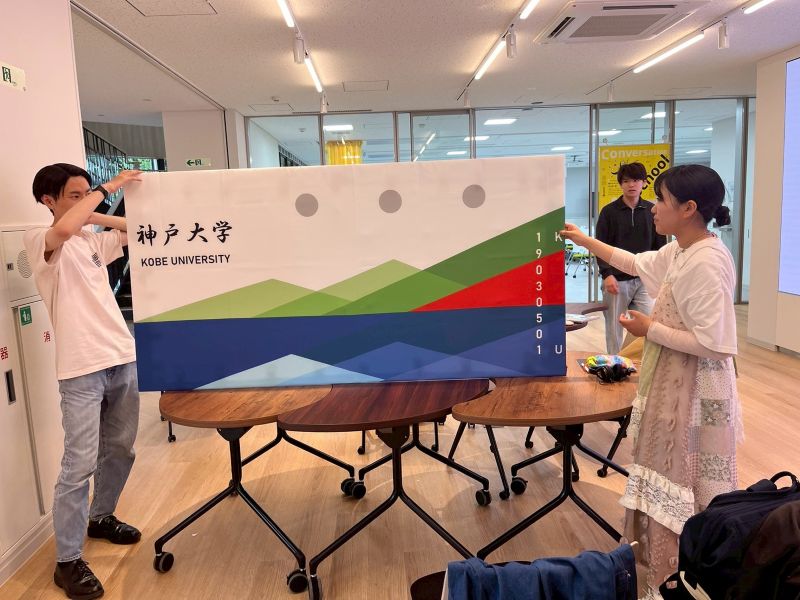
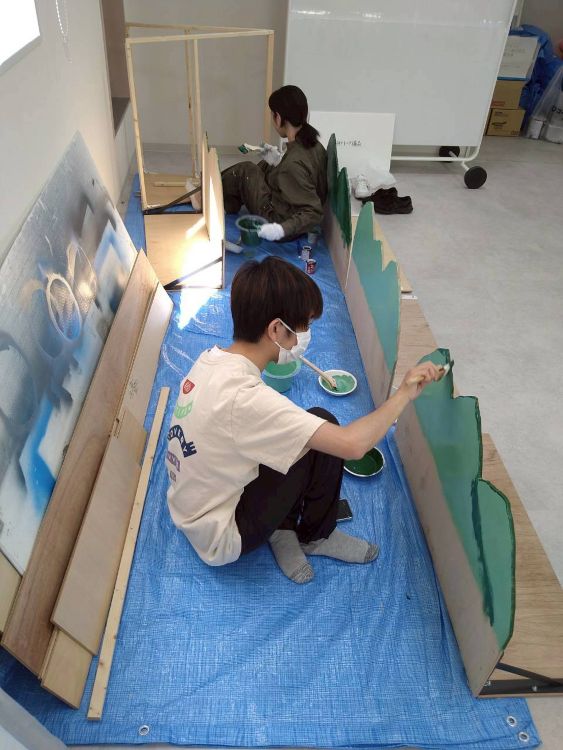
The four leaders come from all different schools and specialties.
KURIYAMA Miya of the Faculty of Global Human Sciences specializes in education. Her major is in STEAM education, which combines science, technology, engineering, arts and mathematics. Among these, she feels the importance of liberal arts and aims to advance to graduate school after graduation.
KUME Shoko of the Faculty of Agriculture researches compound synthesis at the Department of Applied Chemistry in Bioscience Biological Chemistry. She’s got an interest in developing food and medical products and aims to become a researcher in the future.
AKITA Daigoro of the School of Business Administration studies management organization theory and leadership. A motorcycle enthusiast, Akita is investigating the activity of manufacturers and enthusiasts on the topic of “PR strategies of motorcycle manufacturers and consumer activity.”
NAKAMURA Motomi of the Faculty of Engineering is a member of the Department of Computer Science and Systems Engineering. He’s shown an interest in “requirement elicitation,” which investigates which products a company should propose in the current era, an era in which consumer needs are difficult to ascertain.
The four students expressed the appeal of Value School, saying, “Unlike discussions in our respective schools, there are students from majors in all sorts of fields, which makes the discourse both deep and engaging.”
What they learned from the Kobe Festival parade
The procession from Kobe University made its mark on the history of the Kobe Festival parade, which saw participation from 69 groups made up of a total of 5,400 individuals.
After the parade was finished, the four students met again with fresh faces. Kuriyama, the leader of the group, talked about the sense of accomplishment that came with the festival. “It was so fun to hear people cheering for Shindai Uribo from the side of the road. In order to make things engaging in my major, education, you need the ability to take action. We got all kinds of people involved from planning through to execution, so I’ve felt as though I’ve acquired that ability after successfully concluding these efforts.”
Kume, another leader, looked back on the experience, saying, “We didn’t have many opportunities to tell the participants about the performances that the eight of us had planned, so we were worried that we were getting complacent, but after seeing how much fun the performers were having, I felt that we accomplished something even greater than what we had set out to do. I’m so grateful.”
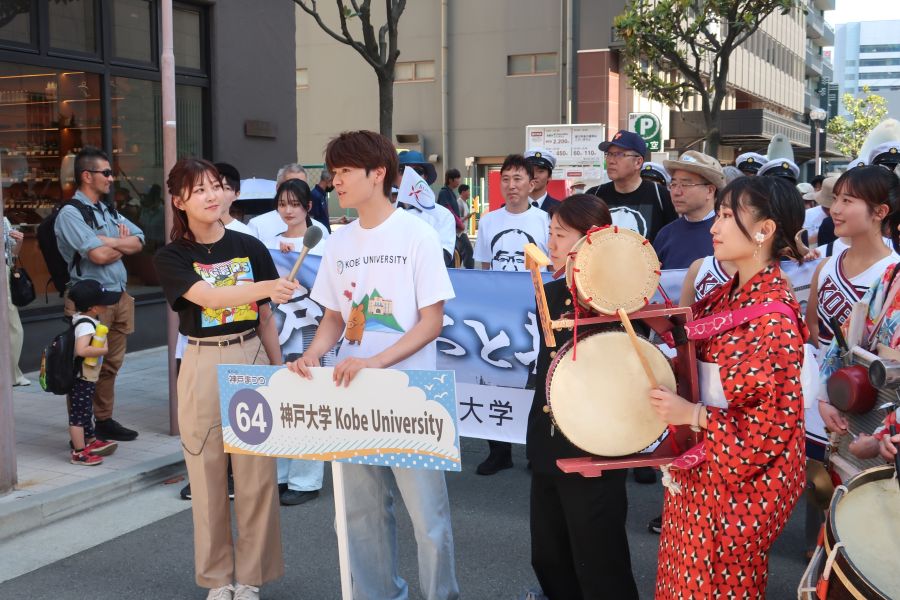
Akita told us, “I haven’t felt this youthful in a long time. Even though there were so many people I was meeting for the first time, including students, faculty and staff, I was moved that we were able to create something with one goal in mind. It moved me to see the parade-goers look so happy, some even emotional.”
Nakamura said, “All the performers were smiling and enjoying the parade. The faculty and students were also physically very close together, which made for a different, lighter mood than what you’d see at the university. We were able to see the project through to completion by communicating to make sure all the members were on the same page.”
Professor Tsuruta, who went right along and oversaw the group from preparation through to the parade performance, looked satisfied, saying, “This project was student led and involved a lot of people, so that they made the parade a reality truly showed me how powerful students can be. They pulled off management, planning and execution in a really tight window, and I’m sure they learned a lot along the way.”
Resumes
KURIYAMA Miya
Born in 2005 in Takasago City, Hyogo Prefecture. After graduating from Kakogawahigashi Senior High School, in 2023, she entered the Faculty of Global Human Sciences at Kobe University. Her major is child education. Her hobbies include visiting cafes and traveling. She’s been to 200 cafes from Hokkaido to Okinawa over the course of three years. She enjoys the eccentricity of each café owner. She lives in Kobe City.
KUME Shoko
Born in 2004 in Ikoma City, Nara Prefecture. After graduating from Nara High School, in 2023, she entered the Faculty of Agriculture at Kobe University. She loves finding exciting things to do, with a wide range of interests including musicals, sports, reading and traveling. She also likes visiting historical buildings. She lives in Ikoma City, Nara Prefecture.
AKITA Daigoro
Born in 2004 in Kobe City. After graduating from Kobe High School, in 2023, he entered the School of Business Administration at Kobe University. His hobbies include traveling alone on his mid-sized motorcycle; he’s traveled over 63,000 kilometers over the two years since he started riding. He says that becoming one with nature is the real thrill of the hobby. He lives in Kobe City.
NAKAMURA Motomi
Born in 2005 in Ogaki City, Gifu Prefecture. After graduating from Ogaki Higashi Senior High School, in 2024, he entered the Faculty of Engineering at Kobe University. His hobbies include traveling and watching the news. He enjoys collecting international news, such as the situation in Iran, as well as domestic news on politics and the economy, and communicating them in a way that’s easy to understand. He lives in Kobe City.