From when life first emerged 3-4 billion years ago, countless proteins that form the origin of life have been endlessly passed down in the natural world. There is, however, a laboratory that is attempting to design and create artificial proteins with functions that don’t yet exist in our world in order to solve problems facing society. Associate Professor TAMURA Atsuo of the Graduate School of Science investigates the possibilities of these proteins in a wide range of fields, such as those for use in COVID-19 vaccines and those that can bond with and recover rare metals. He told us more about the current state of artificial design, how we can implement these proteins into society and what kind of developments we can expect from co-creation with other fields moving forward.
Proteins not found in nature?
What is involved in research for designing proteins with functions not found in nature?
Tamura:
There are many proteins and small-scale peptides that exist in the natural world, something of the order of hundreds of millions. Some 20,000 types of proteins found in the human body are coded by 3 billion genetic base pairs. Once the principles of these natural proteins have been clarified, it’s possible for us to use those principles and design new proteins. I’ve been doing research on this topic for the past 30 years in hopes of creating proteins with never-before-seen structures and functions that can be of use to our world.
The types of artificial proteins with new functions that we can come up with are unlimited. One of these uses is medical applications. In Japan’s aging society, there are a large number of diseases like cancer and Alzheimer’s disease that are difficult to treat. Designing proteins that have the power to treat these diseases by, for instance, targeting cancer cells or delivering medicine, is called “drug design.”
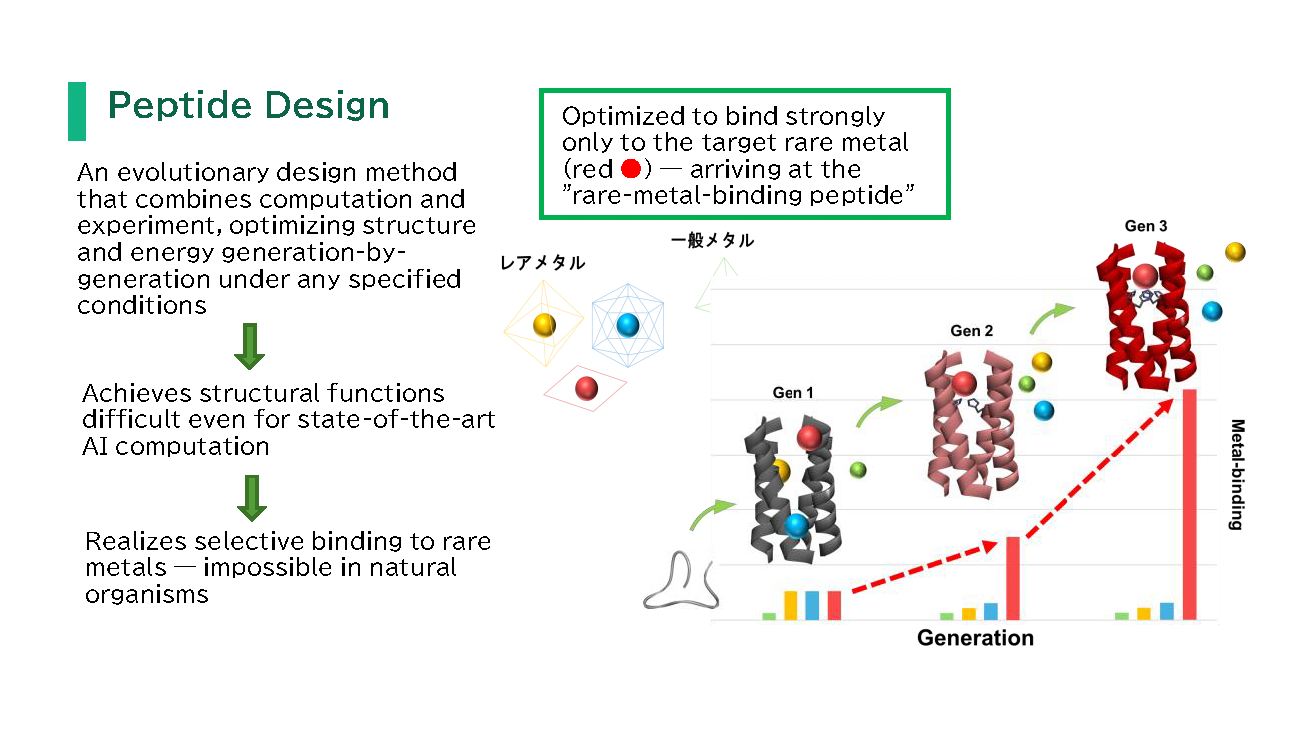
Another use involves industrial applications. Mines in Japan are scarce, so high tech industries rely on imports to acquire precious rare metals like platinum, gold and palladium. We need a stable supply in these tumultuous times, but on the other hand, while there are lots of rare metals in electronic waste, such as cell phones and electric cars that we dispose of, we currently aren’t able to sufficiently recycle them. This is called the “urban mine.” Moving forward, it will be possible to secure the necessary amount of these rare metals from waste, so I’ve worked to design a protein that can bond with and recover rare metals.
Why can protein structures exhibit new functions?
What exactly are proteins anyway?
Tamura:
Well, let’s back up and think about why proteins exhibit functions from the molecular level. Proteins are molecules made up of several amino acids which are themselves comprised primarily of hydrogen, carbon, oxygen and nitrogen. There are only 20 different amino acids found in the natural world. Every single protein and peptide is made up of these 20 amino acids. Short strings of amino acids are called peptides, while proteins are made up of longer strings of 50-100 or so amino acids, sometimes even longer. Proteins form two-dimensional secondary structures, either an α-helix or a β-sheet, as well as specific three-dimensional tertiary structures. It’s not sufficient to just have a long string of amino acids; only once they form a proper structure and exhibit function are they called “proteins.”
Despite only consisting of a string of 20 different types of amino acids, the types of proteins that exist amount to an enormous number. For instance, let’s say we string 100 amino acids together, and there are 20 types of those, so the number of proteins you can make from that structure is 20100. This is a larger number than the number of atoms in the entire universe, so probabilistically speaking, no two proteins are exactly the same. The proteins we design are, barring a completely coincidental match, completely new proteins that don’t exist in the natural world. We design these proteins while thinking about which structures can produce the target functions; for instance, we think about what structures and shapes will react to a certain element.
Specifically, what kinds of new proteins and peptides are you making?
Tamura:
Our bodies are a collection of cells. Inside each cell is a nucleus, and within those are chromosomes and DNA. In the natural world, the DNA sequence information of our genes is converted to amino acid sequences, creating protein structures that exhibit their respective functions. This is called “central dogma,” a fundamental theory of biology in which genetic information is transmitted in a certain direction. The role of DNA is solely to determine the proteins.
”Protein design" reverses this natural flow: we start from the desired function, then design the structure and amino acid sequence to achieve it. Even if the function we’re looking for doesn’t exist in nature, we design them expecting new possibilities. We then decide the three-dimensional structure of the protein we acquire and perform experiments, such as measuring the protein’s function. By using the results of those experiments as feedback to design the next generation, we create all new proteins.
In our laboratory, there are many instances in which we make proteins via chemical synthesis, creating long strings of amino acids by repeatedly adding amino acids and inducing reactions.
To put things more specifically, technology for designing peptides is realized by making use of both calculations and experiments to optimize protein structure and energy, which shows functionality, or in this case metal binding ability. We use calculations to see which elements that make up the structure of proteins, namely hydrogen, oxygen, nitrogen and carbon, can structurally bond easily with a certain material and which can not bond as easily, after which we perform measurements through experiments to verify. Through repeated experimentation we improve the amino acid sequence, improving the protein from generation to generation in order to eventually create a protein with optimal functionality.
There’s a limit to what we can synthesize; usually we make proteins with about 30-40 amino acids. That said, to achieve just one function doesn’t require a protein with a large number of amino acids, so considering productivity and efficiency, peptides, which have fewer amino acids, are enough. If you want to make a large protein, you can use microorganisms to create DNA and easily create proteins of hundreds of amino acids in length. That goes into joint research with biological fields.
Life on earth has continued to evolve for 3-4 billion years, forming the natural world we know today. We can make synthesis of artificial proteins happen in just a few months. When you compare that with the workings of the earth and the natural world, we’re successfully synthesizing proteins at an incredible pace.
We even use cutting-edge AI calculations to achieve previously unachievable structures and functions. In today’s AI-driven world, there’s a software that’s been developed called AlphaFold that predicts the three-dimensional structure of proteins from amino acid sequences. This discovery was selected to receive the 2024 Nobel Prize in Chemistry. However, since proteins that bond to rare metals didn’t originally exist in the natural world, there’s no data on it, so we can’t perform calculations with AI. Since AI can’t design something from scratch that doesn’t exist in the natural world, it can’t create something like our proteins that bond to rare metals.
Proteins that stop COVID-19 infection
You also took part in drug discovery and development during the COVID-19 pandemic.
Tamura:
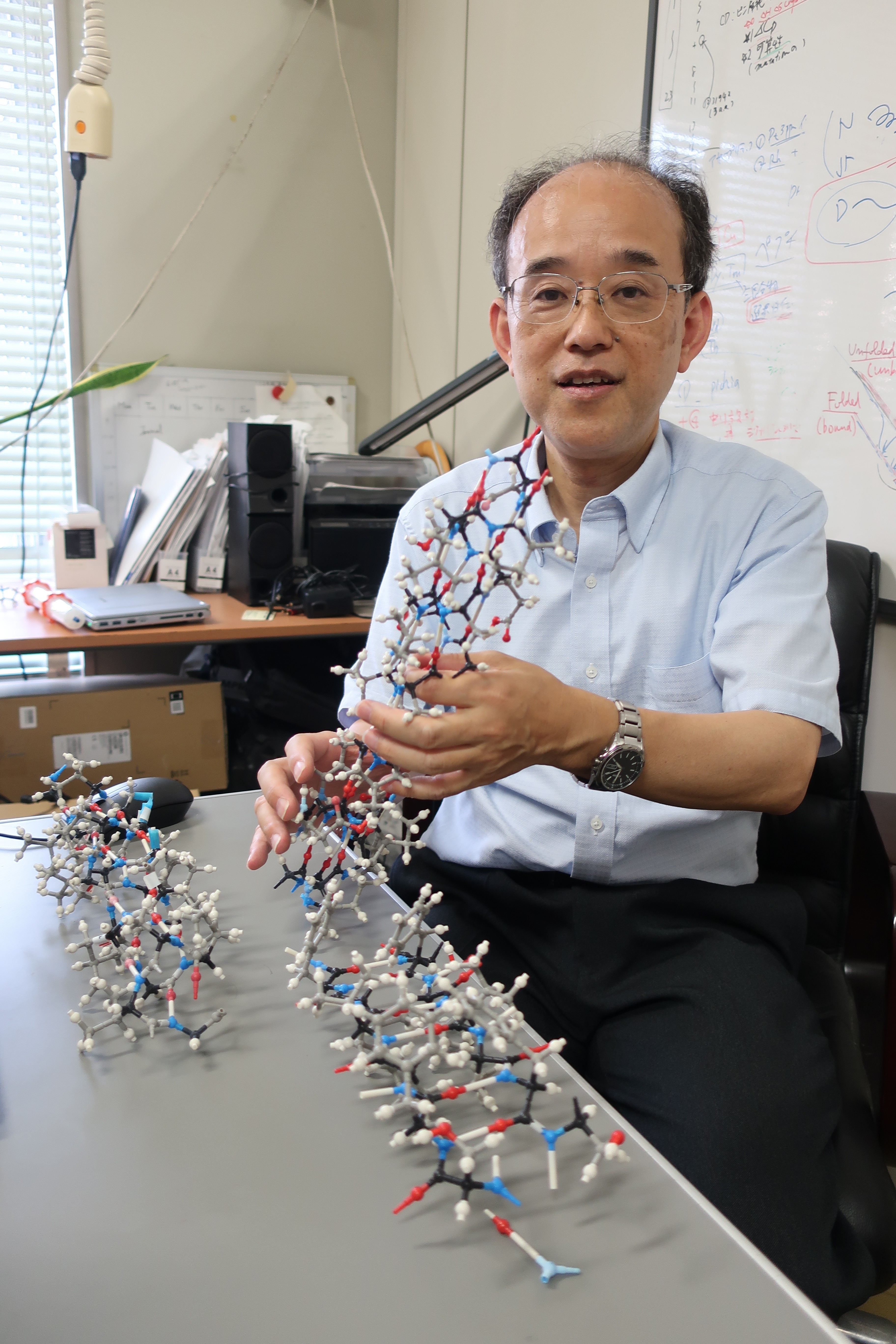
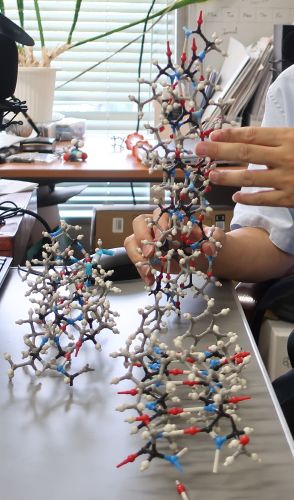
This is a model of a coronavirus spike protein at 100 million times its actual size. The white balls are hydrogen, the black and grey are carbon, the red are oxygen and the blue are nitrogen. This protein model is a combination of 30 amino acids, while the entirety of the spike protein is made up of about 1,000 amino acids.
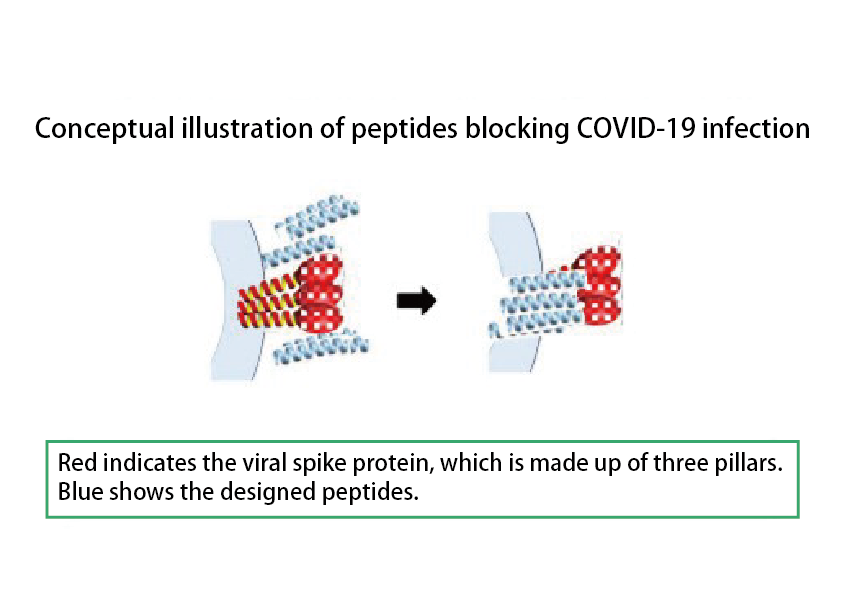
The COVID-19 spike protein is made up of three pillars, with the tip of the protein attaching to human cells and depositing viruses into the cells to cause infection. The tip of this protein continuously changes and variants arise one after another, meaning medicines and vaccines that target this protein become ineffective just as quickly.
So, we put our focus on the base of these pillars on the virus itself which undergoes very little mutation. We designed a protein which attaches itself to the base of the virus, interferes with it, and deactivates it. Spike proteins have settled into a three-prong structure, so by combining similar proteins to destroy that structure and eliminate the viruses’ ability to infect, we succeeded in weakening the potency of the virus.
In our lab, we couldn’t verify if these proteins are actually functioning or not, so we had researchers at Kobe University’s Graduate School of Health Sciences perform research to determine whether virus multiplication had been suppressed or not. We succeeded in developing medicine that was effective even against mutations and submitted a patent for it. Our lab designed a peptide at the molecular level and performed experiments on its actual efficacy at the Graduate School of Health Sciences, making for a successful example of co-creation.
Peptides that bond with and collect rare metals
You mentioned a protein that can bond with and recover rare metals and rare earth?
Tamura:
Japan has few mines and scarce natural resources, but if we recycle resources from urban mines, it’s thought that we could be able to secure the necessary amount of resources. So, through trial and error, we attempted to design a protein that could attach itself to rare metals like gold to collect them. Generally, it’s difficult to prove something that’s impossible, but we changed our approach to something along the lines of “if that something were possible, we might as well prove it by actually making it.”
Our target was rare metals, specifically gold, platinum and palladium, which are in high demand in manufacturing, and rare earth, such as neodymium and dysprosium, which are used in high performance magnets and high-tech devices. There are 17 types of rare earth, but their recovery rates are incredibly poor. Also, lithium, cobalt and nickel are valuable minerals for their use as metals for batteries.
Why did you begin your research on proteins that bond with rare metals?
Tamura:
Previously, we had a company approach us to develop a protein that attaches to gold and conducts electricity. It was always common knowledge that proteins don’t conduct electricity, but we turned that on its head and bonded gold with amino acids to develop a protein called “conductive peptide nanofiber,” for which we acquired a patent. That was just the beginning, as from there, we designed proteins that could bond with all kinds of rare metals, not simply gold with peptides. At the time these were being developed, gold wasn’t as expensive as it is today. As today’s world climate changes, the price of rare metals is continuing to rise. I feel that the times have caught up with the research that I’ve been conducting all along.
As for our recovery targets, there are two ways of thinking about it. One of them is the urban mine, which is another way of saying “recycling.” This method recovers rare metals from high-tech devices such as cell phones and electric cars that have been disposed of. Another way is to recover high quality rare earth from high-concentration rare-earth mud found 6,000 meters deep off the coast of Minamitorishima Island. The University of Tokyo has organized a consortium for these efforts, of which I am a member. Our research can be applied both to recycling from urban mines as well as recovering rare earth from the ocean.
How do you recover these resources specifically?
Tamura:
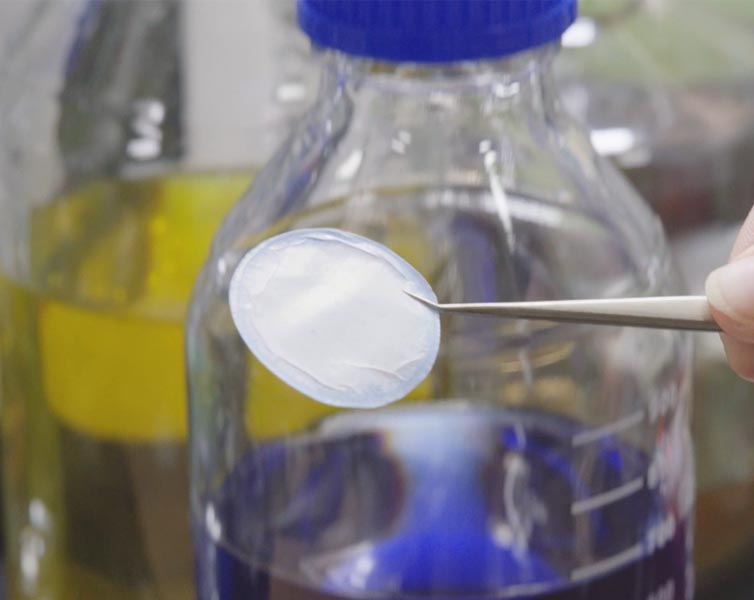
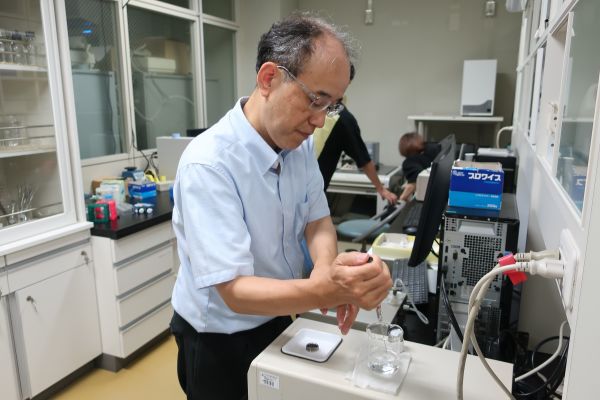
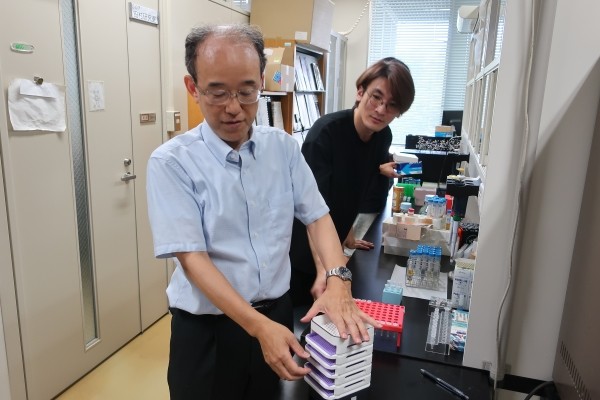
We developed technology that takes the peptide that bonds with rare metals and stabilizes it onto paper. We created recovery equipment that uses cartridges loaded with paper filters coated with peptides for each type of metal. We then pass these filters through a mixture containing rare metals which collects and separates the metals. Some of the benefits to our technology are that it recovers metals quickly, with high selectivity and it is even able to collect metals found in low concentrations. Also, our filters are made of natural materials, making their environmental burden extremely low. Normally, recovery uses heat or movement, but our recovery method doesn’t require any energy either. Our technology is also light, which makes it easy to carry around. You can just take it to a recovery site and recover rare metals and rare earth on the spot. That said, from a future profitability standpoint, we’re still faced with the problem of it being too costly.
Big potential for collaboration and social implementation
Moving forward, what sorts of fields could this research be applied to? How could it be implemented in society, and what kinds of contributions are possible?
Tamura:
I’d like to focus on rare metals and rare earth and create a groundbreaking recovery system to put the finishing touches on that research. I hope to work together with related industries to implement the technology into society. I myself would like to start a business in the next two or three years and work together with lots of companies to make this technology useful to society. Creating proteins and peptides is the most costly right now, so I’m in discussions with companies on how we can manufacture them more cheaply. We’re currently discussing whether we can mass produce microorganisms.
I think that many of the issues our society faces today can be solved by using artificial proteins. Artificial proteins are involved in so-called deep tech, i.e. chemical discoveries and revolutionary technology that solve social issues and greatly impact our lives and our society. There is potential for collaboration in a wide range of industries, including electricity, automobiles, chemistry, oil, metals and biotechnology. Really the only industries where collaboration really isn’t possible are for buildings and other things made of concrete or computational fields in virtual spaces. Besides those, I’m sure it can be involved with anything that has to do with molecules.
Over the course of a year, I continue to design and create anywhere from several dozen to several hundred kinds of artificial peptides. I’ve constantly got dozens of ideas brewing inside of my head, and I’m always thinking about how I can implement these ideas in society. We’ve got a pretty good understanding of the construction principles of proteins, so I’d like to continue developing based on the range of what we understand now to help and even surprise our world. I also toss questions to students in my lab, so we’re constantly coming up with ideas about what we can achieve.
Resume
In 1986, graduated from the Faculty of Science, Kyoto University. In 1988, completed the master's program, and in 1991, completed the coursework for the doctoral program and received his doctorate in science at the Graduate School of Science, Kyoto University. From 1991 - 1995, worked as postdoctoral fellow at Yale University in the U.S. In 1995, became lecturer at the Graduate School of Science and Technology at Kobe University, and concurrently served as PRESTO researcher at the Japan Science and Technology Corporation from 2000 - 2003. In 2006, became assistant professor, and in 2007, became associate professor at the Graduate School of Science, Kobe University.
A video introducing rare metal recovery technology