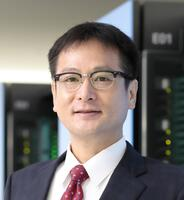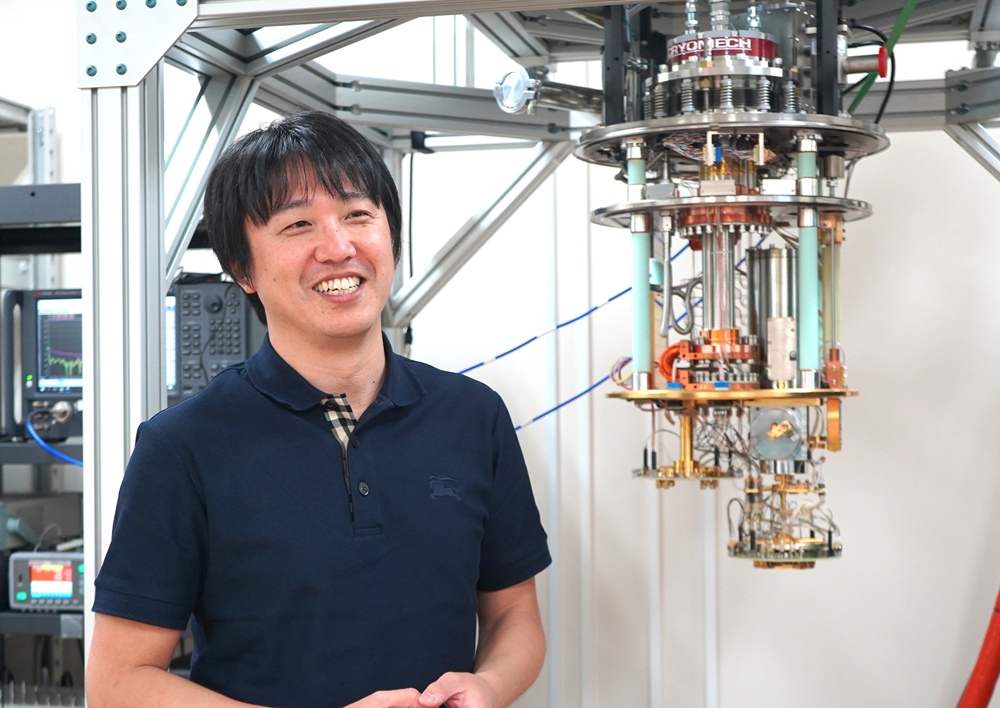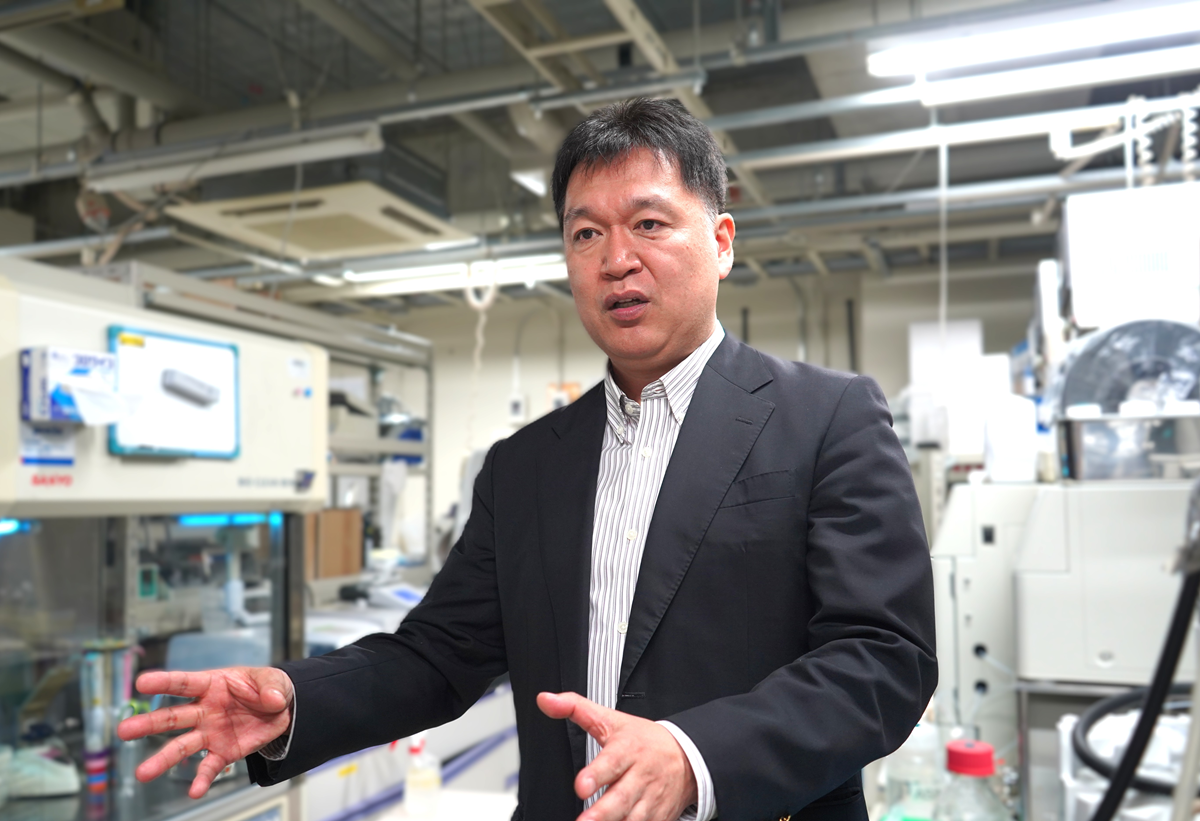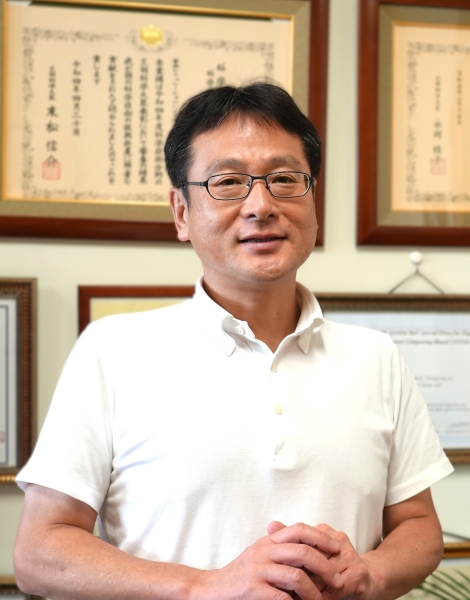
At Kobe University, supercomputer simulations are being used to clarify various kinds of fluid phenomena and help solve social issues. This work is led by Professor TSUBOKURA Makoto of the Graduate School of System Informatics. He is also the team principal at the RIKEN Center for Computational Science (Chuo Ward of Kobe City), which houses the world’s top-level supercomputer Fugaku. Gaining attention with his research on the infection risks of COVID-19, Professor Tsubokura continues to work on projects tackling issues in various fields. We asked him about the current state of his research as well as the future possibilities of simulations.
Visualizing the airflow around moving vehicles through industry-academia collaboration
How did you become interested in simulations?
Tsubokura:
As a university student, my research involved creating metallic thin films that are so thin they are invisible to the naked eye, and I spent my days conducting experiments over and over again through trial and error. But as I wasn’t getting the results I’d hoped for, I started thinking to myself, “Is there a way for us to see what we can’t see?” That was how I became interested in simulations.
When I first entered graduate school, I had a hard time because none of the senior students knew much about the field I was trying to study. It was around then that I became interested in another laboratory’s fluid simulations. Their research studied turbulent flows, or in other words, the complex flow of air or water. I found it interesting because it explored orderly structures that exist within seemingly irregular and disorderly flows.
This was more than 30 years ago, and we already had supercomputers called “vector calculators.” But trying to model turbulence structures was difficult at the time, even with the use of those supercomputers.
Later, you began studying airflows around moving automobiles.
Tsubokura:
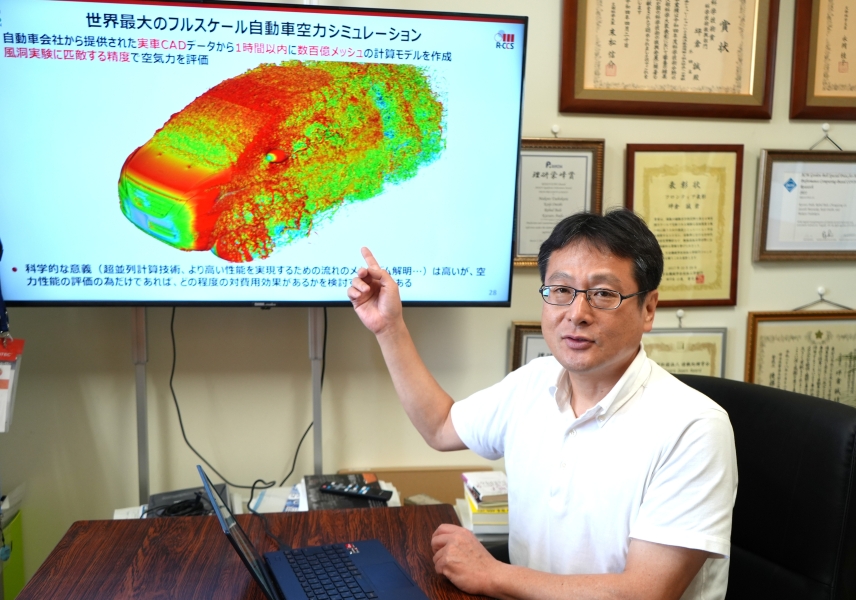
In the early 2000s, we saw the launch of the Earth Simulator supercomputer, which had been developed with the support of the Japanese government to explain the environmental changes in the atmosphere and oceans. Subsequently, my graduate school mentor suggested using this supercomputer to study how air flows around moving vehicles. The government also wanted people to use the supercomputer for projects beyond environmental fields, expanding into the industrial sector, and in particular the automotive industry, as it is one of Japan’s core industries.
With cars, reducing the aerodynamic drag is an important factor in their design. But at the time, there wasn’t a clear understanding of how air flows around a vehicle. Automakers could only take measurements with an actual vehicle over and over again, and reflect the results in their designs through trial and error.
When we analyzed the airflow with the Earth Simulator and shared the results with the automakers, they were very pleased. Of course, they were also doing their own research, but we produced high-resolution simulations with the Earth Simulator, and that was a step ahead. I found it very rewarding to actually see there were people who appreciated my research.
Could you explain the initiative in more detail?
Tsubokura:
We worked on our research, forming a consortium with Japanese automakers and researchers to study automotive aerodynamics. When RIKEN’s K supercomputer began operations in 2012, it enabled us to produce simulations with even higher resolution. We were also able to clarify the scientific bases for technologies automakers had accumulated through experience. Making these things “visible” then prompted further applications in designs and other areas.
It is often said that European cars offer a smooth and comfortable ride even at high speeds, and we have come to understand the reason by analyzing how air moves around the vehicle. When I explained this to a European automaker, they praised me, saying it was wonderful that the reasons had been clarified, and I remember feeling extremely happy.
My research regarding automobiles is still ongoing. Global competition in the automotive industry is intense, and it is a field where the study of computational fluid dynamics, which is my area of expertise, is the most advanced. So our activities with the automaker consortium continue even today.
Droplet dispersion simulations helped with COVID-19 measures
Your research on COVID-19 respiratory droplets had a significant social impact.
Tsubokura:
The Fugaku supercomputer, which is the successor to the K supercomputer, began trial operations in the spring of 2020, when the COVID-19 pandemic started to worsen. The Ministry of Education, Culture, Sports, Science and Technology and RIKEN then announced that Fugaku would be available free of charge for research related to COVID-19.
Our group, comprised of researchers from Kobe University and RIKEN, discussed what we could do, and one member suggested simulating the movement of respiratory droplets that posed the risk of infection. With automobiles, fuel is sprayed into the engine as a fine mist, and the combustion of this fuel produces engine power. The idea was that we might be able to apply the air movement generated by a spray of fuel to simulations of how viral droplets disperse in indoor environments.
So we formed a team, reaching out to infectious disease researchers and people we knew in construction firms, air-conditioning manufacturers, and others in the industrial sector. Since simulations can also be performed remotely from home, as long as you have internet access, it is a very effective research method particularly during a pandemic.
The first simulation we released was about wearing face masks. At the time, the recommendation was to wear them, but their effectiveness had not been proven scientifically. Our simulation managed to clarify that even cloth face masks are effective to a certain extent, and that the effectiveness varied depending on how the masks are worn.
The next simulation we released showed how the droplets from coughing or sneezing spread in the air. It revealed how smaller droplets become aerosol particles (fine particles that are suspended in the air), scattering widely over a long time, and how lower humidity increases the amount of evaporation, making it easier for the droplets to turn into aerosol particles. We were able to perform simulations and visualize many examples of how respiratory droplets disperse, and also show how ventilation can be effective.
At the time, some people believed in unproven methods that claimed to prevent the virus, and so I felt it was extremely important to present scientific data like this. I think it was also a moment that made us see how simulations could have a significant impact on society.
Were there lessons learned from sharing information with the general public?
Tsubokura:
The COVID-19 research was an experience that certainly made us rethink how science should be communicated to the public.
For example, when we published our data on wearing face masks, the media would ask us questions like, “Are cloth masks good or bad?” But our role is to simply present objective data. We believed it wasn’t within our purview to provide messages like, “This is why they are safe,” or “This is why they are dangerous.” That judgment is up to the people who receive the data, and government agencies and others are responsible for implementing specific measures. So our research results just provide an opportunity or basis for people to think about the issue and make decisions.
What developments have there been in COVID-19 research since then?
Tsubokura:
Currently, we are working on simulations to figure out where the viruses multiply and how they spread after entering the body, and we are conducting this research with infectious disease researchers who have been collaborating with us since the beginning.
We are also engaged in research using a method called “agent simulation” to prepare for future pandemics and provide information that can be used as a basis for governmental decisions. These simulate the infection risks or changes in the number of new positive cases by incorporating various elements such as age, gender, and social behavior. We are trying to clarify how a pandemic impacts society based on a comprehensive view that takes into account aspects that range from individual attributes to the flow of people in a community as a whole.
We also conducted similar research during the COVID-19 pandemic, but now we are performing more detailed simulations as part of the Ministry of Education, Culture, Sports, Science and Technology’s “Program for Promoting Research on the Supercomputer Fugaku.”
Research is advancing rapidly with AI and data science
Your research on ski jumping also garnered media attention during the Milano Cortina 2026 Winter Olympics.
Tsubokura:
This is a research project I began around 2007 while I was at Hokkaido University. We use motion capture technology (a technology recording human movements as digital data) to capture a ski jumper’s movements, and we analyze the aerodynamic characteristics and other aspects. But in recent years, advances in data science have led to remarkable progress in the research.
With ski jumping, we accumulate jump data from various athletes and categorize their flight styles. This can help coaches give appropriate advice when they teach other athletes, as they can assess an athlete’s style based on these categories.
Coaches tend to teach athletes based on their own experience, but this may not work out if the athlete has a different flight style. The same can be said for swimmers. With sports, the important thing is to find the best training method for each athlete based on scientific evidence, and I find that interesting.
Developments in data science, driven by the evolution of AI, have also had a significant impact on the automotive industry and other manufacturing industries. It has become easier to identify universal phenomena, and when these phenomena are then learned by AI, various predictions are possible without having to perform complex simulations.
Expanding the communities of software users and developers
What is your vision for future research?
Tsubokura:
Our group basically works on developing software, and the various themes such as automobiles or viruses are areas where we apply this software. We improve the performance of the software based on discussions we have with people from various fields, and that is our style of research. In other words, it is bottom-up research where we evolve software in response to societal needs.
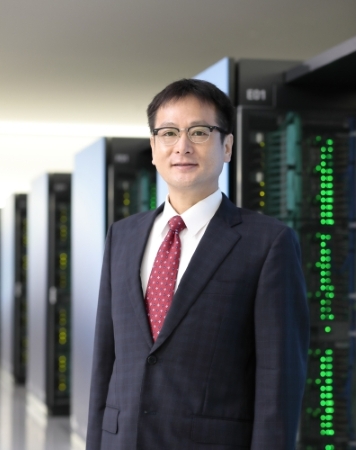
If we then look at the hardware, the supercomputer Fugaku, the FugakuNEXT supercomputer is now being developed, and this will make it easier to combine AI with simulations. FugakuNEXT is scheduled to be launched around 2030, and our group aims to develop software that can maximize their performance on that next-generation supercomputer.
I believe that simulation technology will keep evolving as it merges with AI. If we think about it, AI has only become available to the general public in these past few years, and the paradigm shift in the information world is advancing at a breakneck pace. Besides supercomputers, quantum computers are also said to be extremely useful for certain calculations, and research is advancing rapidly.
As for social issues, I am interested in energy and environmental issues. For example, with the summer heat, I am interested in measures that cities could take to cope with the heat, or methods to improve physical comfort. You could say that measures to combat heat are now a key theme in building a smart city.
I also think that the medical field is important, and recently we have been working with oral surgery specialists. Oral surgery can sometimes leave the patient with speech difficulties, and our research hopes to prevent this problem by simulating the incision site before surgery. Surgery which incorporates these kinds of methods to improve the surgical procedures is called “smart surgery.”
So I hope to focus on three “smart” areas: smart city, smart surgery, and smart infection control.
Nowadays, it is difficult for any research to be conducted by a single group. So I believe it is important to make software available not only to people within our own group, but as many people as possible, expanding the user community. Making the software open source also increases the number of developers and expands the developer community. So I hope to keep an eye on expanding these two communities as I continue with my research in future.
Resume
Graduated from Kyoto University’s Faculty of Engineering in 1992. Completed the master's program in 1994 and the doctoral program in 1997 at the University of Tokyo’s Graduate School of Engineering. After serving as a lecturer at the Tokyo Institute of Technology’s Interdisciplinary Graduate School of Science and Engineering and an associate professor at the University of Electro-Communications’ Faculty of Electro-Communications, he became an associate professor at Hokkaido University’s Graduate School of Engineering in 2007. Since 2012, he has also been the team leader at RIKEN’s Computational Science Research Organization (currently the team principal of the RIKEN Center for Computational Science). He has been a professor at Kobe University’s Graduate School of System Informatics since 2015.