Researchers at Kobe University Research Center for Membrane and Film Technology have developed a new polymer ion-exchange membrane that enables rapid transport of singly charged ions while effectively blocking ions carrying multiple charges, regardless of whether they are positively or negatively charged. By engineering tiny, interconnected water-filled channels, the researchers demonstrated efficient lithium enrichment from magnesium-rich brines and selective salt recovery from simulated seawater, offering new possibilities for sustainable resource recovery.
Key findings
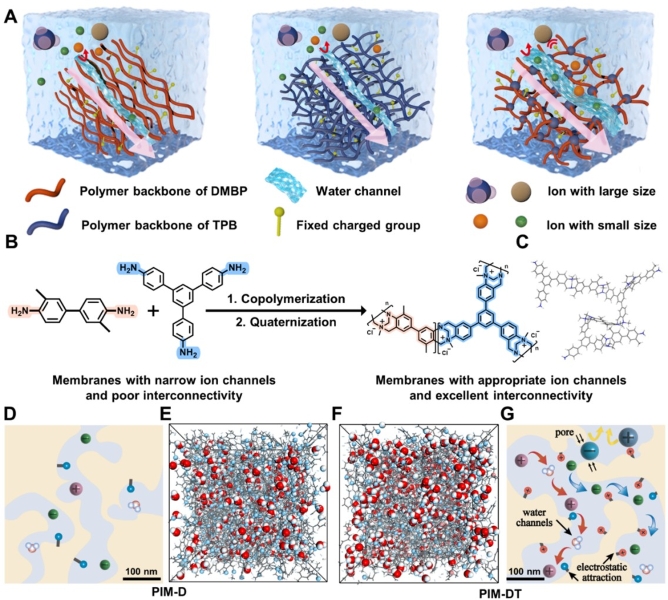
- Developed a rigid, three-dimensional porous polymer membrane with precisely controlled water-filled channels that enable rapid and selective ion transport.
- Demonstrated comprehensive discrimination between singly and multiply charged ions across both positively and negatively charged ionic systems.
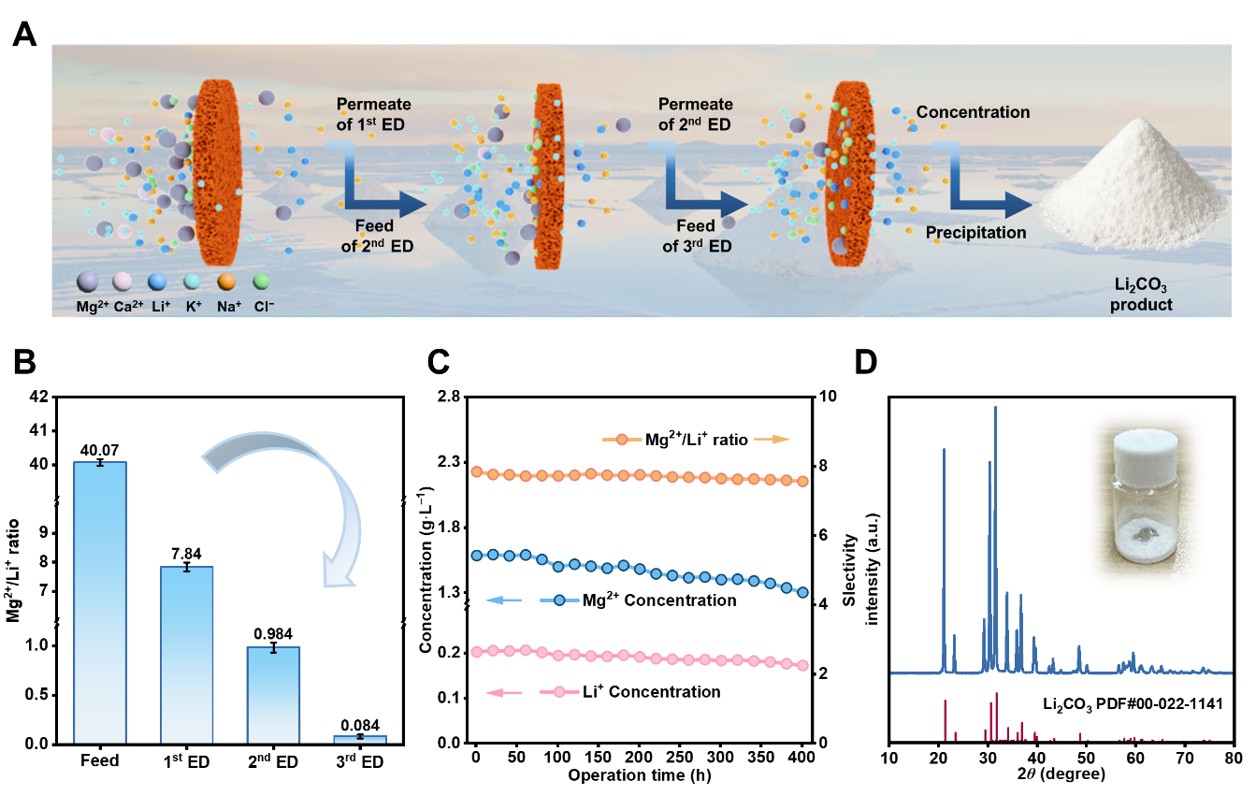
- Achieved an approximately 500-fold reduction in the magnesium-to-lithium ratio during three-stage electrodialysis, followed by recovery of lithium carbonate with 99.5% purity.
Research Background
Lithium is essential for rechargeable batteries, but recovering it from natural resources like salt-lake brines remains challenging. These brines often contain large amounts of magnesium and other dissolved salts, making selective lithium extraction difficult and costly. Similar challenges arise in seawater treatment, where valuable salts must be separated from mixtures of ions with different charges.
Membrane-based separation offers an energy-efficient alternative to conventional chemical treatment. However, existing membranes often face a fundamental trade-off: channels large enough to transport ions rapidly tend to provide poor selectivity, while channels narrow enough to distinguish different ions can severely restrict their movement. Furthermore, conventional ion-exchange membranes are generally designed to favor either positively or negatively charged ions, limiting their ability to achieve comprehensive separation across both ionic systems.
Research Methodology
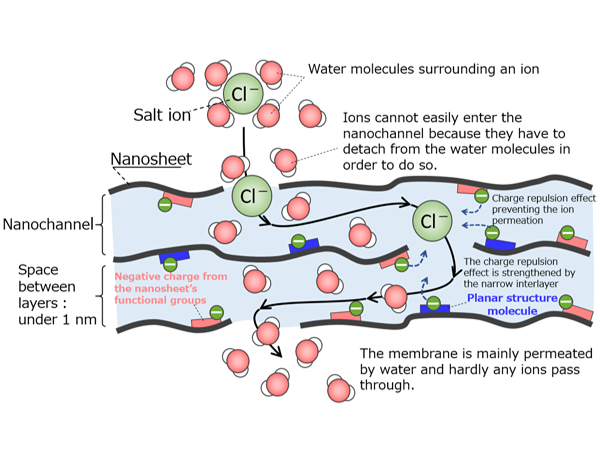
To overcome these limitations, Kobe University membrane engineering researchers LIN Yuqing and his colleagues developed a new membrane based on Tröger’s base-derived porous organic polymers. By combining two molecular building blocks into a rigid, three-dimensional crosslinked network, the researchers precisely regulated the size and connectivity of nanoscale pores. The subsequent introduction of positively charged functional groups promoted the formation of continuous water-filled pathways while preserving the membrane's structural stability.
"Instead of simply making the membrane pores smaller, we focused on controlling how water molecules organize and connect within the polymer structure," explains Lin. "This allows us to create pathways that facilitate the transport of singly charged ions while maintaining strong barriers against ions with multiple charges."
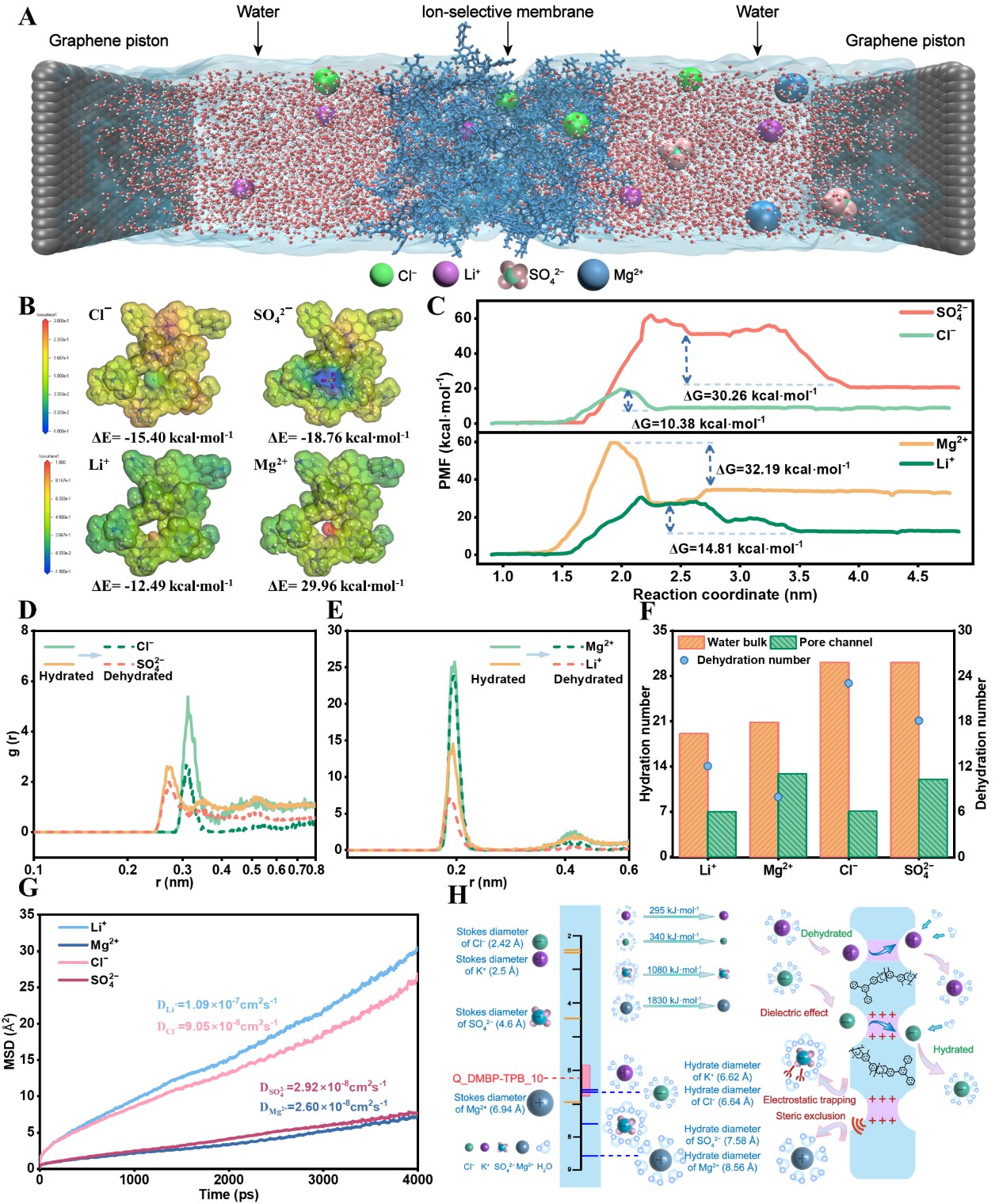
The resulting membrane contains interconnected pores approximately 0.5–0.7 nanometers wide. Experiments and molecular simulations revealed that ion separation arises from the combined effects of nanoscale confinement, partial dehydration, and electrostatic interactions. Singly charged ions can move relatively easily through the hydrated channels, whereas multiply charged ions encounter substantially greater transport barriers.
Importantly, the membrane demonstrated selective separation of both positively charged ions, such as lithium and magnesium, and negatively charged ions, such as chloride and sulfate. This ability to discriminate between singly and multiply charged ions across both ionic systems distinguishes the approach from conventional membranes designed primarily for one type of ionic charge.
To demonstrate its practical potential, the researchers applied the membrane to a three-stage electrodialysis process for lithium recovery from magnesium-rich salt-lake brine. The magnesium-to-lithium ratio decreased from approximately 40 to 0.08, representing an almost 500-fold reduction. The resulting lithium-enriched solution was subsequently converted into crystalline lithium carbonate with a purity of 99.5%. In the seawater treatment, sodium and chloride accounted for 99.4% of the measured ion mass in the enriched solution. These results demonstrate that the same membrane design can address different separation challenges rather than being limited to one specific ion pair.
Research Center for Membrane and Film Technology Professor MATSUYAMA Hideto highlights the broader significance of the findings: "The ability to combine efficient ion transport with precise selectivity is an important step toward more sustainable membrane separation technologies. This approach could open new opportunities for recovering valuable resources from complex aqueous streams."
Looking ahead, the researchers aim to explore the use of these membranes in larger-scale separation systems and evaluate their performance under practical operating conditions. Further improvements in membrane manufacturing, durability, and process integration could help reduce the energy consumption and chemical requirements associated with lithium recovery and salt purification.
Acknowledgements
This research was conducted by researchers from Kobe University in collaboration with East China University of Science and Technology, Nanjing Tech University in China, and Hanyang University in South Korea.
The study was supported by the Japan Society for the Promotion of Science (JSPS KAKENHI JP25K23530), Intergovernmental Cooperation of Science and Technology Program of Shanghai (22520710800), China Postdoctoral Science Foundation (2025M781178), Science and Technology Program of XPCC (2025AA005), National Research Council of Science & Technology of Korea (25081-300), and National Research Foundation of Korea (RS-2025-02309471).
Original publication
Sun, H., Gan, N., Wu, B., et al.: "Hydration channel engineering in Tröger’s base-POP membranes for mono/multivalent cation and anion discrimination." Science Advances, 12, eaef9368 (2026). https://doi.org/10.1126/sciadv.aef9368
Published: October 9, 2026.
Release on EurekAlert!
Angstrom-scale water channels help membranes recover lithium and purify salt
Inquiries
For inquiries, please contact gnrl-intl-press[@]office.kobe-u.ac.jp