

While tics have been considered to result from an aberrant function of the brain’s motor cortex, a Kobe University mouse study has now discovered a connection to the brain’s emotional functions. The result promises a new avenue of research on treatments for Tourette syndrome.
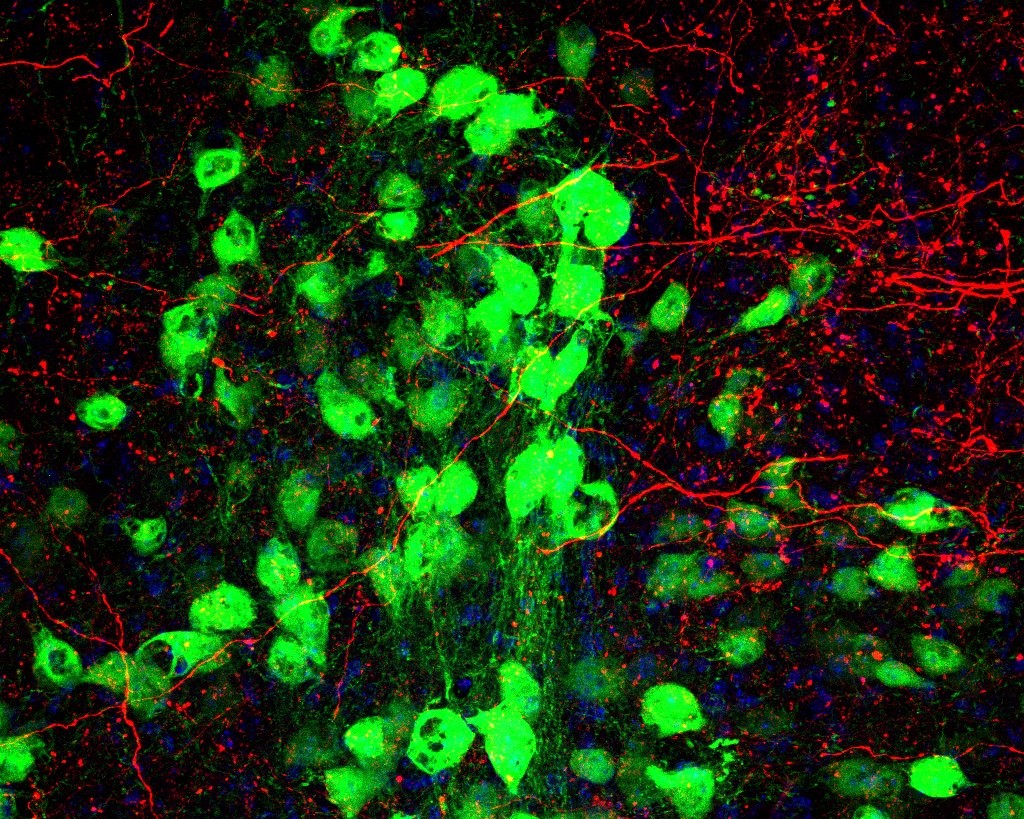
“Tic disorders, such as Tourette syndrome, are among the most common neuropsychiatric conditions and have a significant impact on children’s lives. However, their underlying neuronal mechanisms remain poorly understood,” says Kobe University neurophysiologist TACHIBANA Yoshihisa. Researchers of the field have come to understand that there is a circuit in the brain’s motor cortex that causes the motor tics when malfunctioning. However, a hallmark of Tourette’s is the “premonitory urge” felt by people with the condition, and the condition is often accompanied by others such as obsessive-compulsive disorder, attention deficit and hyperactivity disorder or autism spectrum disorder, which hints at an involvement of other brain regions. Tachibana explains, “Indeed, brain imaging studies of people with tic disorders have reported abnormal activity in the insular cortex, which is responsible for emotional processing and internal awareness, but there has been very little research on the relationship between tic disorders and this region.”
Tachibana, who specializes on the connection between “the body” and “the mind,” has previously published that two thirds of Tourette’s patients wearing a dental mouthguard showed marked improvements of motor and vocal tics. They traced the neurons responsible for perceiving muscle movements and found that they connected to the insular cortex, suggesting that tics can be ameliorated by changing the way this region is connected to the brain’s motor cortex. To test that hypothesis, the researchers now set out to elucidate how these regions are connected and how manipulating the connection changes tics in a study that involved mice in which tics were artificially induced.
Kobe University neurophysiologist TACHIBANA Yoshihisa specializes on the connection between “the body” and “the mind” and utilizes methods that allow live imaging of the activity of individual neurons in model mice. The video shows the activity of the motor cortex before (left) and after (right) the injection of bicuculline, an inhibitor of a specific class of receptors on neurons (bottom left), which they used to induce tics in their model animals. © H. Kuno et al., Cell Reports 2026 (DOI: 10.1016/j.celrep.2026.117272) (CC BY)
In the journal Cell Reports, they report their discovery of a neuronal connection from the motor cortex via an intermediary thalamic relay station to the insular cortex. This relay station is relevant, too, because it has been used as the target for a therapy of Tourette’s using deep brain stimulation, even though it wasn’t clear why it works. In addition, they showed that by inhibiting this connecting pathway, they could markedly reduce the strength of tics, albeit not their frequency. “We believe that the neuronal circuit we found plays a crucial role as a bridge connecting brain regions that were previously thought to act independently from each other,” comments Tachibana.
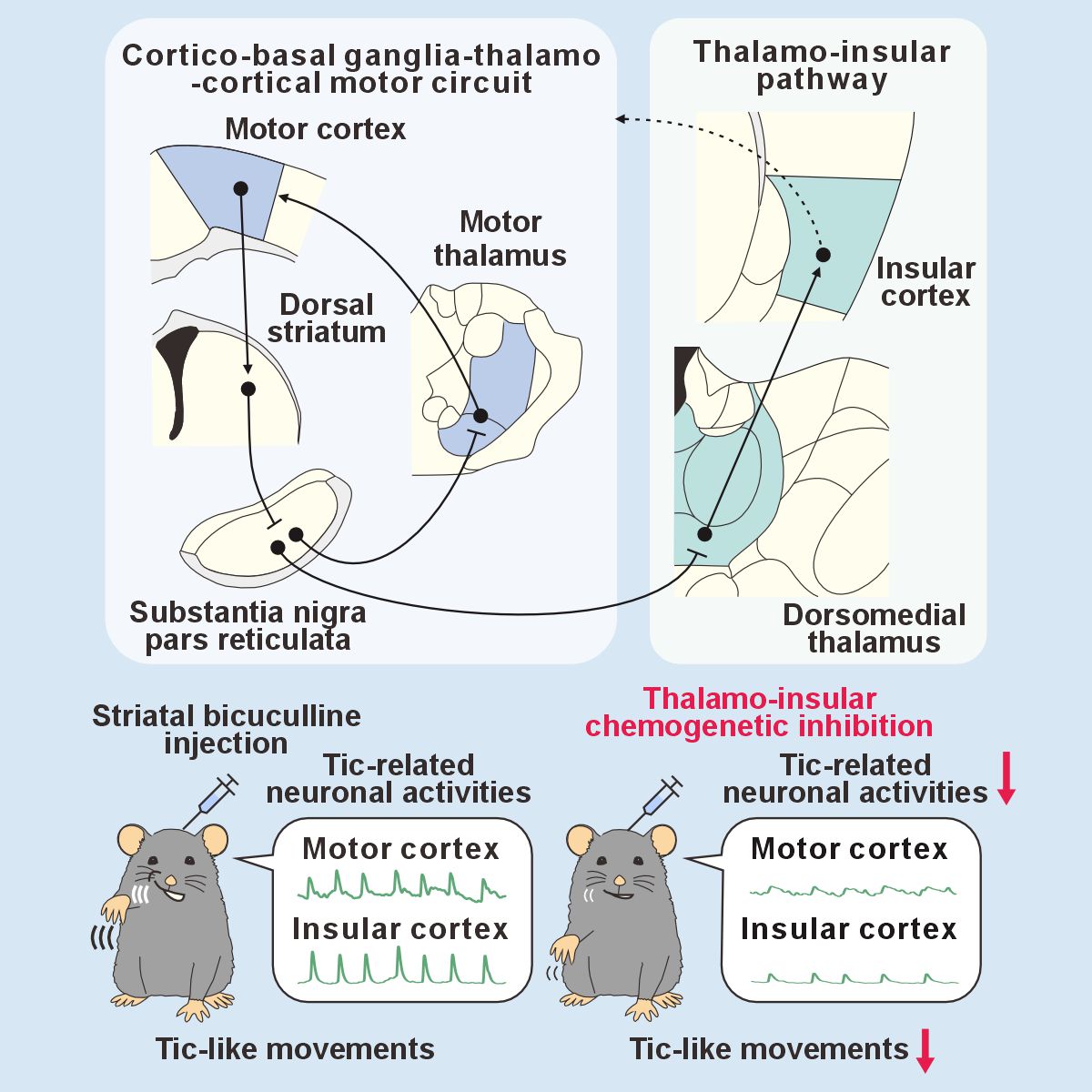
In their study, the researchers further explain that they still think that the motor tics are possibly generated by the aberrant function of the brain’s motor cortex, but the connection they found probably explains how this dysfunction spreads to other regions. This may therefore not only explain where the emotional and cognitive symptoms of Tourette’s come from, but also why the condition is so often accompanied by other neuropsychiatric disorders.
At the same time, the connection also suggests a new avenue for research on a treatment. Tachibana says: “The currently used deep brain stimulation is invasive and comes with a risk of complications. On the other hand, targeted intervention of the neuronal processing in the circuit we identified, such as ultrasound neuromodulation, may be options for the development of less invasive and safer treatment methods.”
Acknowledgments
This research was funded by the Japan Society for the Promotion of Science (grants 18K06852, 22K19732, 24H00422, 24K02339, 24H00620), the Taiju Life Social Welfare Foundation and the Japan Agency for Medical Research and Development (grant JP23wm0625001). It was conducted in collaboration with researchers from the National Institute for Physiological Sciences and the Graduate University for Advanced Studies, SOKENDAI.
Original publication
H. Kuno et al.: Intralaminar thalamus relays basal ganglia output to the insular cortex to drive tic generation. Cell Reports (2026). DOI: 10.1016/j.celrep.2026.117272
Release on EurekAlert!
Feeling the urge: Motor and emotional crosstalk for tic generation
Inquiries
For inquiries, please contact gnrl-intl-press[@]office.kobe-u.ac.jp