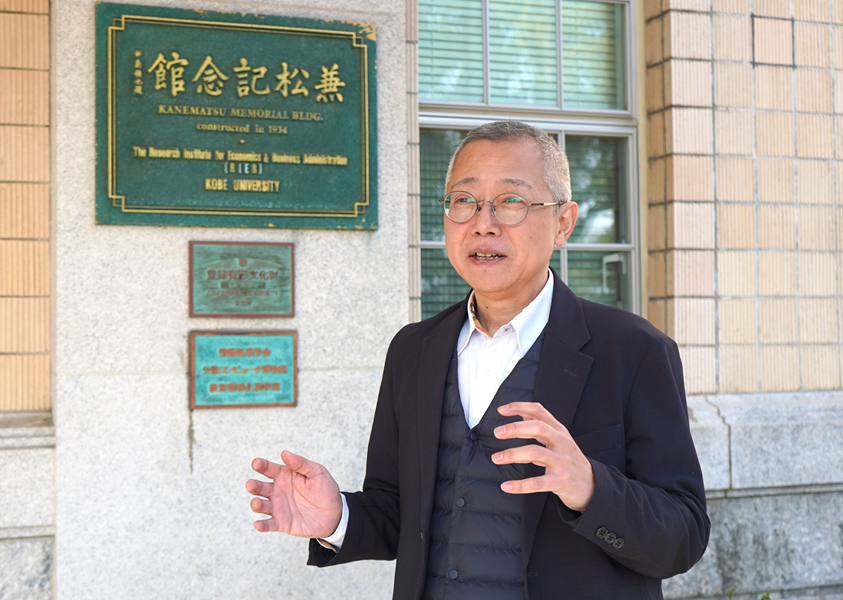



As the world economy is upended by the attacks on Iran by the US and Israel, and the Russian invasion of Ukraine entered its fourth year without a ceasefire in sight, it’s impossible to know what will happen next in today’s global society. Even the UN, the international organization established to maintain peace, has fallen into a state of dysfunction due to the actions of these permanent members of the Security Council, with no solution to be found. We sat down with Professor HAYASHI Mika of the Graduate School of International Cooperation Studies, an expert in international law, to hear more about the role of international law in these chaotic times and how the international community should respond.
Attacks on Iran by the US and Israel are in violation of international law
The attacks by the US and Israel on Iran and the invasion of Ukraine by Russia have profoundly disrupted the global order. As an expert in international law, how do you see the current state of the world?
Hayashi:
The majority of international lawyers are saying, and I’m one of them, that the attacks by the US and Israel on Iran are in violation of the prohibition on the use of force, specifically, in light of the UN Charter. Both the US and Israel basically claim that these attacks are acts of self-defense, which the international lawyers find hard to accept. While it is true that certain use of military force for self-defense is justified in international law, there must be a clear distinction of the following three scenarios.
The first scenario is when a country is actually being attacked. The second scenario is one where a military attack is imminent. The third scenario involves a threat in the future. The first and the second cases are those that are clearly established as self-defense in international law. We can’t say the same for the third case, which is where the present case comes in.
In the present case, the US and Israel weren’t facing any imminent attack, in the sense understood in international law. Here is a hypothetical scenario. If the state they were attacking had completed the production of nuclear weapons and made its intention clear what they were for, and if the situation was such that it must be stopped immediately or else the target states risk a nuclear attack, this would be an imminent threat in the context of the right to self-defense. However, that was simply not the case; the situation was very far from that level of imminent attack. The Iranian government did make hostile remarks about Israel in the past, but hostile remarks do not mean an attack is imminent. If such remarks alone could constitute a reason for self-defense strikes, military strikes against one another would take place too often and too easily.
If I may go back to the third scenario, accepting that as a case of self-defense is an extremely slippery way to go. If you say this is an acceptable scenario of self-defense, then the line between a military action for self-defense and an action which is not self-defense but simply deterrence becomes very blurry. It’d be so blurry that there would hardly be any line.
At the beginning of the invasion of Ukraine, Russia also referred to the right of self-defense in their communication to the UN Security Council. However, in this example again, an “imminent threat” in the sense understood in international law was missing. If they were saying that NATO’s growing influence and its growing close relationship with Ukraine was a threat to Russia, it was not an imminent threat that could trigger self-defense in international law. To initiate attacks because of a possible attack at some point in the future and claim that it’s a defensive war is really a stretch. To accept pre-emptive attacks against a future threat as self-defense is to erase the line between an invasion and an act of self-defense. In my eyes, this is the same problem we discussed in relation to the attacks on Iran.
In the case of the invasion of Ukraine, there is a problem of disinformation, too. Russia basically claimed in the same communication to the UN Security Council that Russia wanted to protect people subjected to genocide in Ukraine. International law defines genocide as the killing, forced transfer of children to another group, and so on, with the intention to destroy a certain group of people, but there wasn’t any evidence of this happening. It’s frightening to think that disinformation of this scale is sold to the public as a reason to start an aggression.
The importance of not staying silent in the presence of self-serving superpowers

First off, what is international law? Is it functioning in these tumultuous times?
Hayashi:
International law in the context we’ve been discussing is a set of rules and principles for states. They’re mainly made up of treaties, which are agreements between two or more states in a written form, and customary international law, which is unwritten and is a set of rules created by state practice accumulated over time. States that are party to a treaty must observe that treaty, and customary international law is binding on all states.
However, neither category of rules has a built-in system for imposing sanctions on states that violate them. The international community is basically a “horizontal” community, one without hierarchical relationships. International law that functions within that horizontal community cannot really have a system of punishing those that do not respect international rules.
Because of this characteristic of the community in which international law operates, staying silent in the face of violations is a bad idea. When a state criticizes or condemns a violation of a rule, even though such a criticism alone is unlikely to stop an illegal act, it may still have weight in the public opinion, and combined with various other forces, it may help bring about change.
On top of that, international law has a rather unique problem of its own when it comes to silence regarding rule violations. Since international law is formed by arrangements and custom of the states themselves, if states are silent in the presence of illegal actions, there is a danger that over time, because of continued general silence, the illegal actions may come to be seen as lawful. From that viewpoint, too, it is disheartening that only a very limited number of states expressly criticize the military actions against Iran today.
When Russia invaded Ukraine, more than 100 UN member states voted for a resolution in the General Assembly condemning that invasion. In contrast, the majority of the US allies, including Japan, didn’t criticize the attacks against Iran as an issue of international law. Illegal use of force occurred many times in the past, but if the majority of states condemned it as an infringement of the rule, then one could see that the rule in question was considered valid by those states. Tacitly accepting the illegal acts can be, for international law, as damaging as the illegal acts themselves.
A single state can’t stop a powerful state from starting a war in any case. Nevertheless, staying silent is not a good option. We know that the US today is very unlikely to listen to what other states say, but as I said, there is distinct meaning in making one’s opposition known. It’s still not too late.
Within the UN, a permanent member of the Security Council can “veto” a decision of the Security Council. This has been a known phenomenon for a long time. Today, the issue is that some of these permanent members, responsible for international peace and security, wage war in violation of international law. These states have acted in violation of the UN Charter, and the international community is facing a critical juncture in history.
Well then, is international law powerless against acts of major powers?
Hayashi:
International law cannot stop states that are determined to go to war. The rules on the use of force are disregarded, so in that particular sense, you could probably say international law is powerless.
However, Russia and the US do not overtly refute international law itself. On the contrary, they do heed the rules. These states emphasize that their actions are in accordance with international law. This indicates that even these states don’t believe that international law is powerless or meaningless.
In terms of usefulness, a branch of international law such as the law of armed conflict or international humanitarian law is useful and needed during wars. The law of armed conflict limits violence during wars to what is deemed necessary and tries to prevent unnecessary harm to civilians. There are, of course, violations in this branch of law, too, but that shouldn’t make us forget many instances of compliance. Law may not be able to stop wars, but it can limit the damage, and that’s a useful role this branch of law is playing.
Additionally, international law is important in post-war negotiations, for example, regarding reparation or in some cases, determining borders. Basic rules one can find in international law are useful as they can be acknowledged as a starting point by both parties during such negotiations. If they further agree, rules of fact-finding may be useful, too.
The role and limits of the International Criminal Court
Are there any organizations in the international community that can punish countries when they violate the rules?
Hayashi:
According to the UN Charter, the UN Security Council could fill that role. But as you know, when it is a case against one of its permanent members, it can’t.
The International Criminal Court (ICC) is an interesting phenomenon as it tries to introduce an idea of hierarchy in the horizontal international community. At the moment, though, the ICC is an organization that prosecutes individuals and not states. Moreover, as the ICC’s jurisdiction is established by a treaty known as the Rome Statute of the International Criminal Court, what it can do with regard to non-states parties is limited. The actors of the current wars, namely the US, Israel, Iran and Russia, all remain outside the ICC. The ICC, in principle, has no jurisdiction on the actions of these states, taken in these states; so the fewer the states parties, the smaller the scope, or jurisdiction, of the ICC becomes. Nevertheless, Palestine is a state party to the ICC, so the ICC could consider the actions of Israel that occurred in the territory of Palestine as falling within its jurisdiction. But issuing an arrest warrant for Israel’s current Prime Minister Netanyahu was met with fierce backlash, not only from Israel but from the US as well.
How does China view international law?
Hayashi:
That’s a very interesting question. China stresses it respects international law. One can also see that it is true, that in many instances China acts in accordance with international law. At the same time, China’s joint statements with Russia that refer to international law also show a critical view of international law and its operations in certain fields. China doesn’t accept the decisions of the South China Sea arbitration, either. This mixture of signals makes it hard to say whether they see international law as something useful or something they accept as is.
In connection with China, I’m paying close attention to the Arms Trade Treaty. Japan and many European states are parties to this treaty. One of its rules is that a state must refrain from issuing an export license if a risk assessment shows a clear risk, called overriding risk in the treaty, that the weapons could be used for violations of international humanitarian law.
Now, China has acceded to the Arms Trade Treaty and emphasizes that 1) transfer and export of weapons should contribute to legitimate self-defense capacity of the recipient country, 2) arms transfer should not undermine peace, security and stability of the region concerned and the world as a whole, and 3) the trade should not interfere with the internal affairs of the recipient country. However, the third point, non-interference with the internal affairs of the recipient state, is potentially damaging to the Arms Trade Treaty’s goal I mentioned, for this could mean that China doesn’t want to examine closely how the weapons they export are going to be used in the recipient state. So I’m very interested in learning how China really feels about the risk assessment required by this treaty and whether or not they can successfully implement it.
But I also want to stress that risk assessments of arms export are difficult everywhere, not only in China. Since 2023, the UK and the European states have faced litigations regarding arms export to Israel. I haven’t come across any concrete case of concern for China, and how China responds to similar issues under the treaty will be something I’m very interested in.
Unexploded ordnance from the Vietnam War in Laos
Today’s international community is headed for military expansion. Is there any way we can stop it?
Hayashi:
While states around the world are spending more for their armaments today, a few disarmament treaties are still operating properly and as expected. The Anti-Personnel Mine Ban Convention and the Convention on Cluster Munitions are such examples. A goal of these disarmament treaties is, among other things, to remove landmines and unexploded ordnance left after conflicts. Reducing the contaminated zones by removing landmines and other unexploded ordnance is to reduce civilian casualties. Successful examples and efforts under these treaties remind us that not all is lost in the area of disarmament.
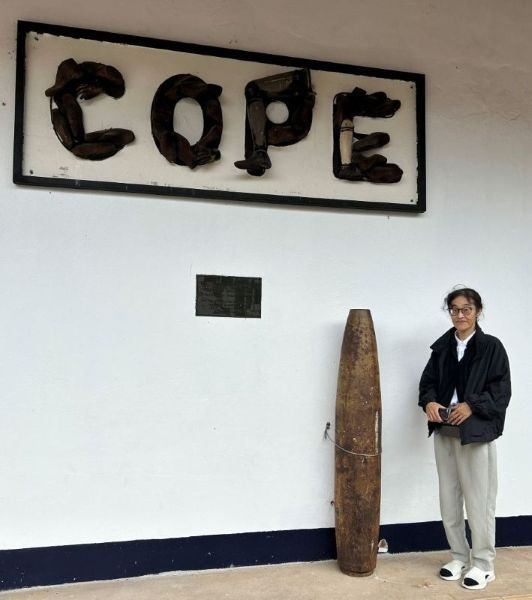
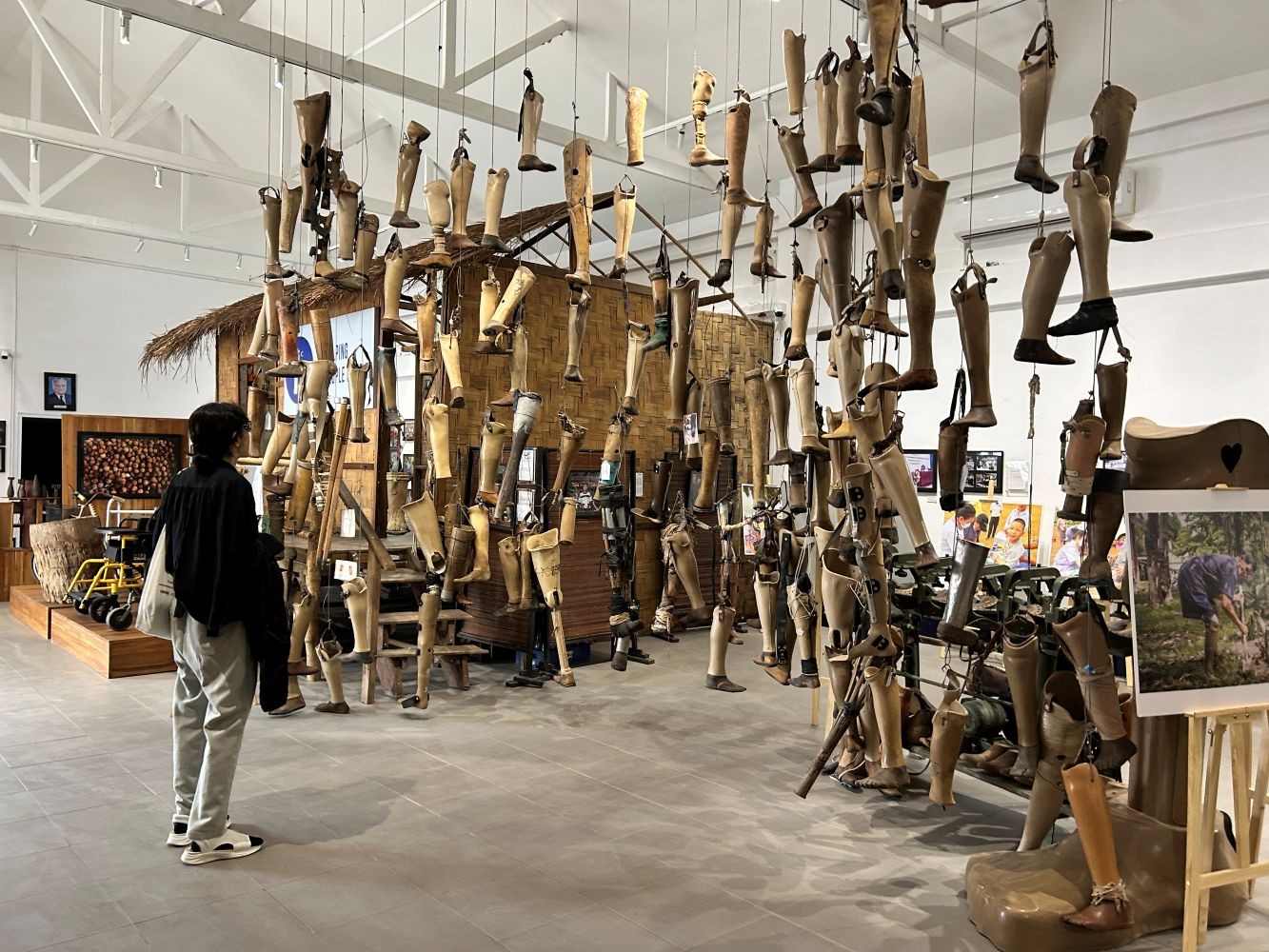
In 2025, I visited the National University of Laos for a symposium. Laos still has areas contaminated by unexploded ordnance from the Vietnam War, which ended in 1975. Since the fighters from North Vietnam used a passage in Laos, that part of Laos was repeatedly struck by the US. Half a century later, Laos is still unable to remove all the unexploded ordnance. Capitalizing on the Convention on Cluster Munitions and international support, Laos provides risk education to the vulnerable people, and has done a great deal for the clearance. In fact, the clearance of the unexploded ordnance is officially the 18th SDGs of Laos. The US, while not acknowledging any legal responsibility for the unexploded ordnance, expressed its moral responsibility, and provided assistance for the clearance in the past, including its information on locations of the strikes. This type of disarmament may seem insignificant compared to, let’s say, nuclear disarmament, but it isn’t insignificant. The efforts don’t get much attention, but there is real progress in the achievement of these disarmament treaties.
That said, even these disarmament treaties are not immune to the changing security environment. Following the Russian invasion of Ukraine, the Baltic states, Estonia, Latvia and Lithuania, as well as Poland and Finland, all of which share a border with Russia, withdrew from the Anti-Personnel Mine Ban Convention. From the perspective of national security, the Mine Ban Convention is no longer beneficial for these states. States agree and abide by the rules that have benefits for them, and they don’t if the rules bring them more harm than benefit, or are not useful enough. This is how treaties work. Withdrawing from a treaty like the Mine Ban Convention is a signal that conveys the positions of these states regarding the treaty. In international law related to security, states have always made their assessment regarding national security and what is feasible for humanitarian concerns, then adopted or repudiated the rules.
If international law is powerless, what can third countries do?
Moving forward, is there any research you’ll be carrying out in the field of international law that will reduce the damage inflicted by wars around the world?
Hayashi:
I’d like to think that yes, there is. We can’t stop a war, and the parties to an armed conflict do not always respect international humanitarian law. Against that background, I’d like to focus on what third states, that are not parties to an armed conflict or a war, can legally do to ensure the respect of law. Third states can of course release statements against wars and violations, but there are very few clear rules pointing to specific measures. As one of the few practical and lawful options, third states not involved in a war can contribute to reducing the violence in a war by arms export control. This line of thinking led me to the Arms Trade Treaty.
The Arms Trade Treaty tries to ensure transparency of arms transfer, about the destination and the end users, and it doesn’t prohibit arms export to conflict zones. Nevertheless, states parties must carry out a risk assessment of their arms export. As I said, there are litigations in Europe brought by NGO’s regarding arms sales in light of the Arms Trade Treaty. I’d like to examine these lawsuits to verify whether, and to what extent, the Arms Trade Treaty can clarify what third states of a conflict can and should do to ensure respect of law, when there are signs of violations of international humanitarian law. There is little third states can do when wars are happening, and even fewer things they are obliged to do by law, but there’s got to be something, and I intend to find out.
Resume
In March 1993, graduated from the Faculty of Law, Kyoto University. In September 1995, completed her course at the École nationale d'administration, France. In March 2000, received her Master of Arts degree at the Graduate School of Arts and Sciences, University of Tokyo and stayed on for the doctoral program until 2003. From April 2000 to March 2003, served as research fellow of the Japan Society for the Promotion of Science. In April 2003, joined the Graduate School of International Cooperation Studies, Kobe University, as an assistant professor and received full professorship in October 2013. From January 2006 to March 2007, was visiting researcher at the Max Planck Institute for Comparative Public Law and International Law, Germany.