

Movements to restrict immigration are picking up steam in the US, itself a nation of immigrants. Based on its “America First” ideology, the second Trump administration, which began in 2025, has proposed a series of hardline policies, such as limiting the acceptance of refugees and mass deportation of undocumented immigrants. As antiforeign movements continue to build strength, trends in municipalities called “sanctuary cities,” which are tolerant to undocumented immigrants, are also gathering attention. We sat down with Graduate School of Intercultural Studies Professor YASUOKA Masaharu, an expert on US immigration policy, to hear more about Trump administration policies and the current state of sanctuary cities.
*In Japan, immigrants without a status of residence are called “illegal immigrants” or “illegal residents,” but abroad, the terms “irregular” and “undocumented” are generally used based on a resolution by the United Nations General Assembly.
COVID-19 influenced immigration policies
How do you view the immigration policies of the Trump administration?
Yasuoka:
During the first Trump administration (2017-2021), they weren’t able to execute the sort of hardline policies we see today. The president’s policies were stopped by the judicial branch, due in part to a fierce series of court battles facing Trump. The president’s supporting staff also weren’t as comfortable with the work during his first term. Most of all, the COVID-19 pandemic itself played a huge role in putting a stop to the mass influx of immigrants to the US.
During the Democratic Biden administration (2021-2025) that followed, the COVID-19 pandemic came to an end, so immigration activity picked up once again. Compared with the policies of the Trump administration, however, immigration policies became more “lenient” under Biden. This leniency was criticized as not being able to control the influx of immigrants and even became a factor for Republican Trump’s eventual victory in the presidential election.
In this second Trump administration which began last year, Trump’s staff has become more comfortable with operations than the first administration, and now with the conservative majority in the Supreme Court, the legislative branch is having a difficult time curbing the administration’s policies, which has led to greater pressure on immigration. The National Guard and Immigrations and Customs Enforcement (ICE) have mobilized to crack down especially hard on cities that are uncooperative with the president’s policies.
At least 500 sanctuary cities in the US
So, these so-called “sanctuary cities” have become the target. What kind of places are sanctuary cities, anyway? How many of them are there across the US?
Yasuoka:
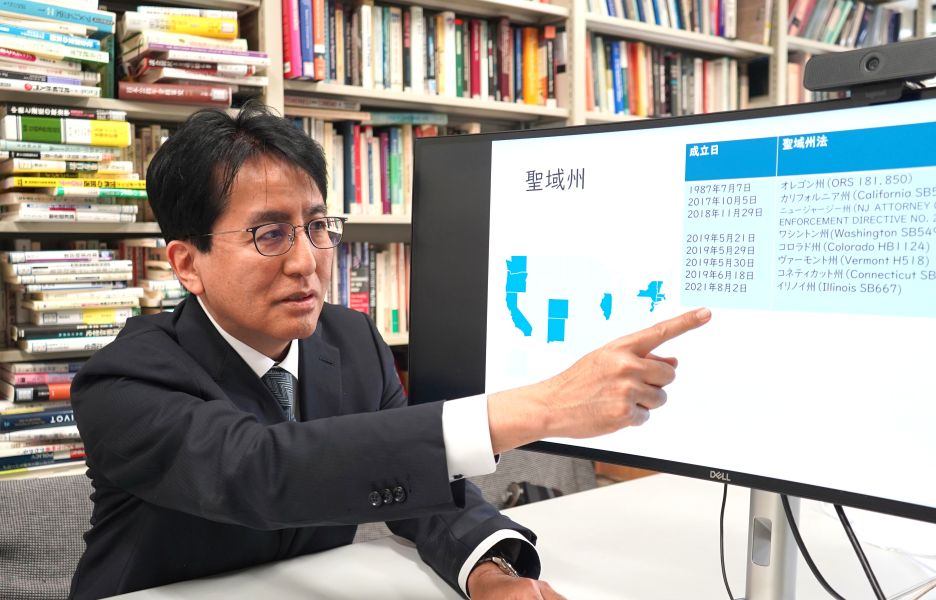
Sanctuary cities are, to put it simply, municipalities that limit cooperation in providing information to the federal government regarding a resident's immigration status. There are sanctuaries at the state level, like Oregon and California, large cities like San Francisco and Los Angeles and smaller cities, as well.
While there are places where measures to not provide information to ICE have been established as state laws, ordinances, etc., there are also municipalities that have not made such measures public. There are somewhere between 500 and 1,000 of these municipalities, mostly concentrated on the west and east coasts where support for the Democratic Party is strong.
In Japan, laws can only be enacted at the national level, but in the US, the independence of the states is maintained so much so that there are debates as to whether federal law or state law should be prioritized. Basically, the states and cities do not wish to be seen as simply “subcontractors” to the federal government. Laws regarding immigration control are the jurisdiction of the federal government, so sanctuary cities’ responses are that “cracking down on undocumented immigrants isn’t our job” and that “we have no responsibility to cooperate with the federal government.”
The state and city police arrest criminals for things like murder and theft, but they don’t have the authority to arrest undocumented immigrants who have stayed in the US past their allotted period of stay. That’s the job of federal agencies like ICE. Another reason why sanctuary cities don’t cooperate with the federal government is that if federal agencies within states and cities were able to detain residents based on looks alone, this would give too much authority to the police and would lead to human rights violations.
In Japan, the police are seen as a virtuous organization that enforces the law, without really thinking about how it feels to be the one having the law enforced upon them. On the other hand, in the US, citizens are sensitive to the possibility that the police and the Federal Bureau of Investigation could infringe on their human rights.
What specific kinds of trends are we seeing now during the Trump administration?
Yasuoka:
To this point, establishments like churches, hospitals and schools had been places where even undocumented immigrants could stay with peace of mind. Called sensitive locations, there is an unwritten rule that protects these places from immigration enforcement activity. Even if parents don’t have an official immigration status, their children’s right to receive an education had been protected. However, currently, ICE has now begun to intervene even in such sensitive locations in compliance with the intentions of President Trump.
On top of that, last year, President Trump signed a presidential order demanding a reexamination of birthright citizenship. In the US, even if both parents are undocumented immigrants, any child born inside US borders is a legal citizen, but they’re trying to change that system. At the moment, hearings have begun in the Supreme Court as to whether or not this order is constitutional, for which we’re still waiting on a ruling. If they end up limiting birthright citizenship, US immigration policies will see big changes, but this would also require an amendment to the constitution.
What’s concerning about the future direction of immigration policy is that even after a change in administration, what had been done by the Trump administration can’t easily be undone. Even if the administration returns to the Democrats, while intervention into sensitive locations will see a decrease, I don’t think things will ever go back to the leniency we saw during the Biden administration.
Immigration policy a point of contention both in Japan and abroad
Even outside of the US, antiforeigner movements also seem to be strengthening in Europe and Japan. Are there any connections between them?
Yasuoka:
Formerly, refugees were frequently accepted by countries all across Europe, but these past 10 years or so have seen far-right political parties come to power in several countries, and with them, movements to enhance restrictions. President Trump’s frequent public statements that would have previously been seen as discriminatory may have made it easier for other politicians to follow suit.
Even in Japan, immigration policy was a point of contention during the 2025 House of Councillors election. Though, in Japan’s case, so-called immigration policy and issues related to inbound travelers from overseas seem to have gotten jumbled up. I think it’s also been influenced by the fact that it’s now easier to see the movement of people after the walls between borders that stood high during the COVID-19 pandemic have all of a sudden been lowered in the pandemic’s wake.
Politicians making an issue of immigration policy is something that happens all over the world, including Japan. However, while politics move toward being mindful of a certain domain and entitling the people within it, like a country of sorts, our globalized world has people moving across national borders more freely than ever.
Even in countries with strict enforcement like the US, there is a real issue in that if immigrants leave, including the undocumented ones, then a good number of industries will go under. Thus, the Trump administration is keeping immigration policy as a point of contention while strengthening and weakening enforcement as it overlaps with economic activity. This relationship with the economy is also something we need to keep our eyes on.
Japan used to send off its own as immigrants
Is there anything to that Japan can learn from the history of the nation of immigrants that is the US?
Yasuoka:
Formerly, Japan was the one sending its own citizens to live in places like the US and Brazil as immigrants. In the US, the Johnson-Reed Act of 1924 was passed, which prohibited immigration of Japanese citizens to the US, and Japanese Americans were forced into internment camps during World War II. I think we need to become more aware of the hardships these people faced throughout their lives. In Kobe, the building used as a base of operations by the people moving to places like Brazil is now preserved as the Kobe Center for Overseas Migration and Cultural Interaction.
Generally, immigration policies have four kinds of objectives. The first are economic objectives, in which immigrants move to countries where they can acquire a higher income, while the countries that receive the immigrants either get laborers for lower cost than their own citizens or laborers with advanced technical skills, achieving economic growth. The second are social objectives. Immigration policy in the US takes family reunification as a general rule, allowing laborers who emigrate for economic reasons to have a family and build a community among fellow immigrants. The third are cultural objectives, in which people from a variety of cultural backgrounds gather together and better each other to strengthen the nation. The fourth are moral objectives, in which developed countries believe that they should take in individuals that are victims of human rights violations in their countries of birth.
Up until the present, the US has considered these cultural objectives as its strength, taking in all kinds of immigrants. The country has also emphasized diversity in rectifying the discriminatory policies in its past, such as the Johnson-Reed Act of 1924. I feel that Japan needs to learn from this history when proposing future policy. Look at the US and how its diverse peoples have bettered each other in strengthening the nation; taking in foreigners could lead to new opportunities for Japan as well.
What have you discovered in your research on sanctuary cities?
Yasuoka:
Strict enforcement by the second Trump administration has caused a sense of fear among immigrants in the US, and I also get the feeling that officials in sanctuary cities have tightened their guard, judging from what I’ve observed through interview surveys. Even so, I think there’s a lot to learn from the nature of sanctuary cities.
During interviews with sanctuary city officials, I hear that “We’re not a city that’s kind to undocumented immigrants. We just don’t want to discriminate against residents.” For instance, if an undocumented immigrant feels as though they could be detained at any time, they won’t report to the city if, say, they’ve contracted a dangerous illness. Also, if a municipality requests information on undocumented immigrants from its residents, essentially mutual surveillance, then there would be many people who would find it difficult to live there. Municipalities want to prevent this kind of situation from happening.
The term “illegal immigrant” often used in Japan brings to mind images of individuals forcing their way across the border. However, there are many who have entered the country legally but lost their status of residence for one reason or another, becoming “unauthorized immigrants.” There are also those who are waiting for refugee status. I want people to know that each country is the same in that among the individuals of the “illegal immigrant” population, each has their own set of circumstances.
Japan’s immigration objective is often given as “multicultural coexistence,” but even without such a slogan, we’re already living with foreigners. There are many industries that couldn’t function without foreign workers. Convenience store workers, caregivers and construction workers, just to name a few. Now that foreign residents have become an indispensable part of the economic system, they’ll continue to integrate themselves into Japanese society.
It goes without saying that there are people of different cultures and religions living in any particular region, regardless of whether they’re foreign residents or not. In reality, we’re already building society together. It’s important to make gradual efforts, such as increased mass media coverage, to put these aspects in the spotlight.
Resume
In 1993, completed the master’s program at the Graduate School of Political Science, Waseda University. From 1995-1997, studied abroad at the University of Virginia (USA) and received a master’s degree in political science. In 1999, completed the doctoral program at the Graduate School of Political Science, Waseda University. After serving as a postdoctoral research fellow of the Japan Society for the Promotion of Science, in October 2000, became associate professor at the Faculty of Intercultural Studies, and in October 2020, became professor at the Graduate School of Intercultural Studies, Kobe University. His recent books include “American Politics (2nd edition)” (co-author, edited by OKAYAMA Hiroshi and NISHIYAMA Takayuki, 2024).