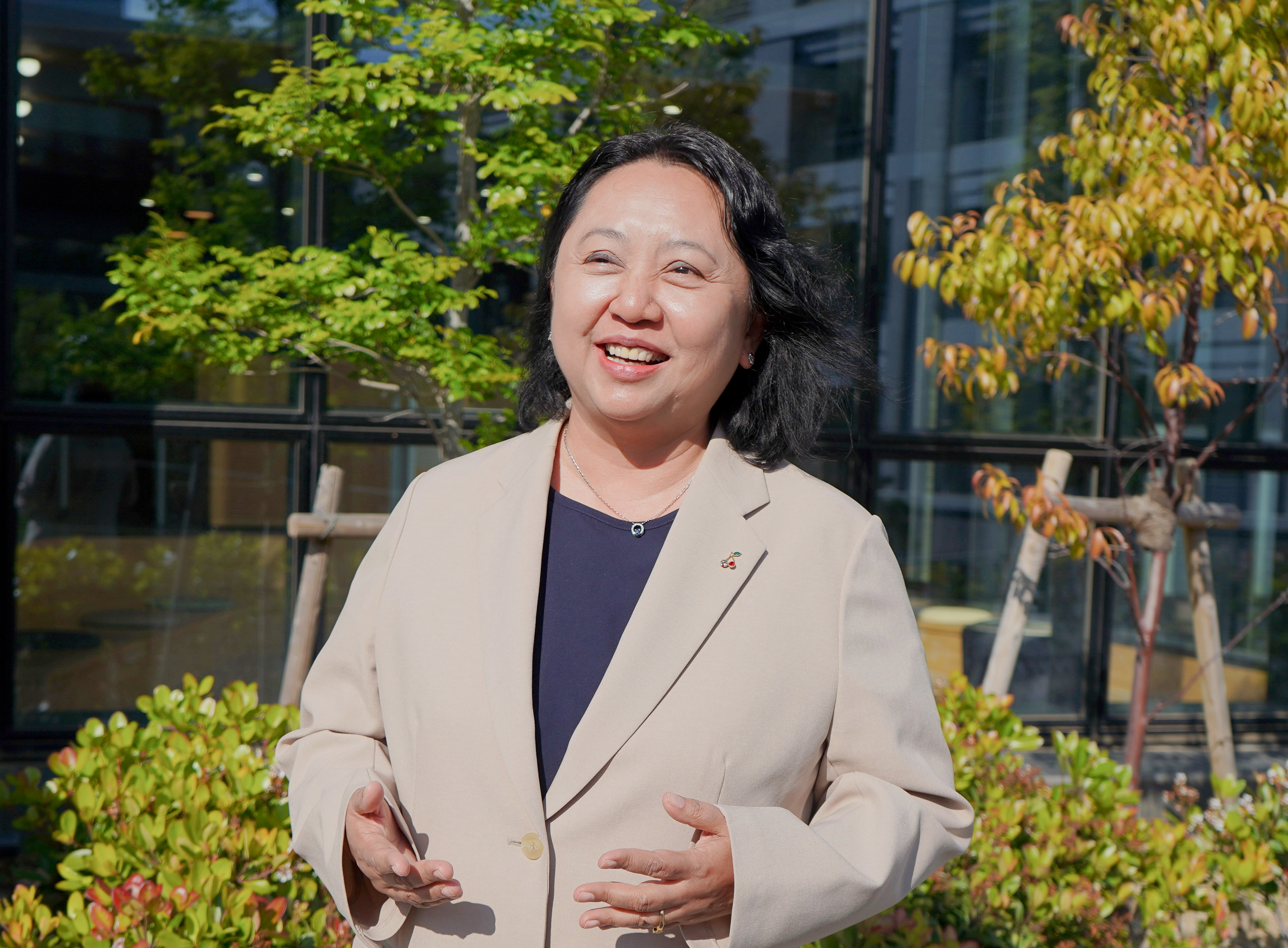


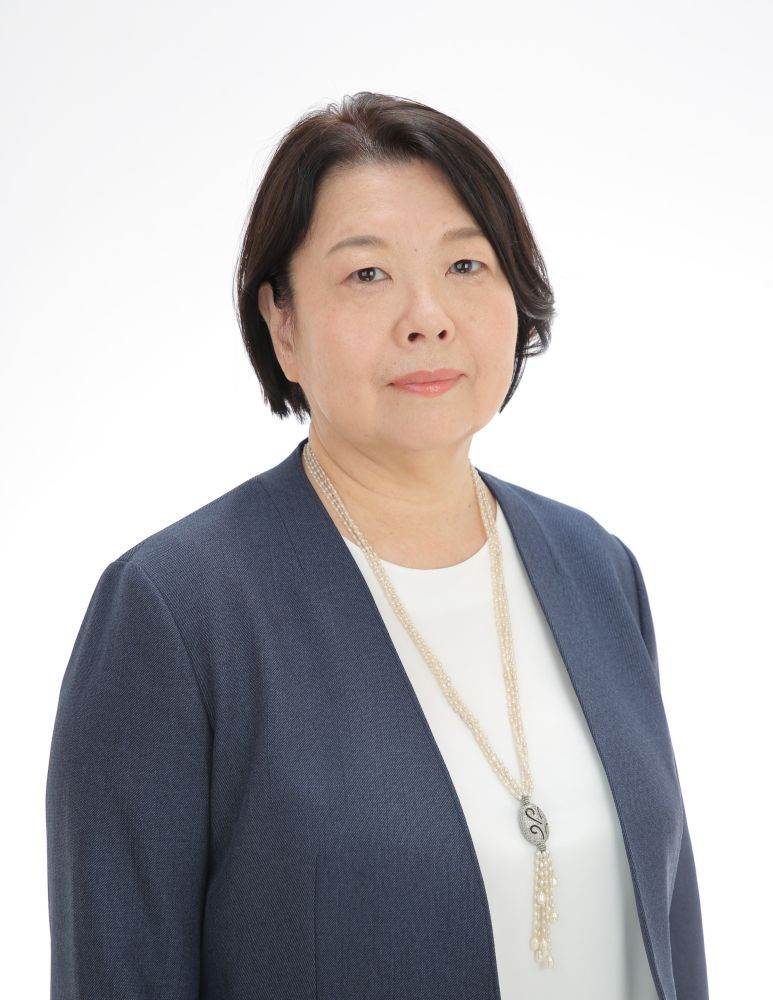
Known as the civil engineer who orchestrated the construction of India’s metro railways, Kobe University Graduate School of Engineering alum ABE Reiko has spent more than 19 years living in India. She’s also an executive officer of a major construction consulting company and chairperson of its Indian subsidiary. Her accomplishments were covered on the NHK program “The Professionals” and have earned her numerous accolades. But she encountered one hardship after another along her path as a woman in the engineering field. We sat down with Abe, who also devotes her energy to guiding and training those who wish to follow in her footsteps, to hear about the emotions she puts into her work and her message for the next generation.
Women couldn’t even reach the starting line
Abe is from Yamaguchi Prefecture. As a child, she was amazed when her father drove her through the undersea tunnel that runs through the Kanmon Strait (between Yamaguchi and Fukuoka prefectures). At the time, she never even dreamed that she would become a civil engineer, but after entering university, she developed an interest in civil engineering, feeling a mysterious connection to memories from her childhood.
After studying at Yamaguchi University’s Faculty of Engineering, Abe “wanted to build huge structures,” so she searched for work at a general contractor. However, at the time, there weren’t any companies that were hiring women for management-track positions, so her faculty advisor at Yamaguchi University recommended that she enter graduate school. She was told that she should start by studying at a graduate school in the city in order to expand her knowledge as well as her connections.
Even at graduate school, there weren’t many civil engineering labs who were taking in female students. But Kobe University Professor SAKURAI Shunsuke (now professor emeritus) opened the doors of his lab to Abe. Though she was the only female student in the lab at the time, everyone got along well, be it for research or recreation.
“The relationship between professor and students as well as among the students themselves was very tight, so it was a very fulfilling lab to be a part of. I wasn’t necessarily all that passionate about research, but the connections I made at Kobe University turned out to fit like the perfect pieces in the puzzle of my life. Without those, I wouldn’t be who I am today.”
Connections with Kobe University carved a path for her career
Abe’s connections with Kobe University guided her when searching for a job after completing graduate school. She ended up taking an interview with Konoike Construction Co., Ltd., whose president, KONOIKE Kazusue, was a graduate of Kobe University’s Faculty of Engineering. As she faced the hurdles that come with job hunting as a woman, this opportunity was provided to her by Professor Sakurai. And she certainly made the very best of it, as she passed the interview examination and became the company’s first female civil engineering in 1989.
However, she wasn’t assigned to a site where she could put the tunnel engineering she studied at university to use. “There was a superstition that if a woman entered a tunnel construction site, the female mountain god would be sent into an envious rage and cause an accident, so I wasn’t allowed in.”
Even so, this was during the peak of the bubble economy. The company was taking on projects like construction of an underground shopping street, so Abe’s work in numerical analysis, the area to which she was assigned, was very busy. However, after a while, that bubble was beginning to burst. Her boss at work told her, “Your lack of on-site experience is going to cause you trouble eventually. Find something only you can do,” and recommended that she apply to study abroad via an in-house program. This was about five years after she joined the company.
English was tough for Abe ever since she was a student. After some intense studying, she passed the examination for the in-house study abroad scholarship system. She ended up entering the Norwegian Institute of Technology (now the Norwegian University of Science and Technology), which was introduced to her by Professor Sakurai.
Life didn’t go smoothly abroad either. The language barrier was a particular challenge, which came with a crushing feeling of isolation.
“Not only did I not know anyone, but the sun also barely comes up in the winter in Norway, so I was depressed. It was at that time that Professor Sakurai came to Norway on his ‘way back from a conference.’ He also spoke with my professor, and from then on things started to gradually take a turn for the better.”
After finishing her studies abroad, Abe looked all over for opportunities to train at a construction company in Norway, and she ended up getting a year of on-site experience. Once a weakness of hers, she turned her English ability into one of her strengths, and after returning home, she was put in charge of the Taiwan High Speed Rail, which was being worked on by Konoike Construction, spending some 4 years in Taiwan.
Cultures clash in India
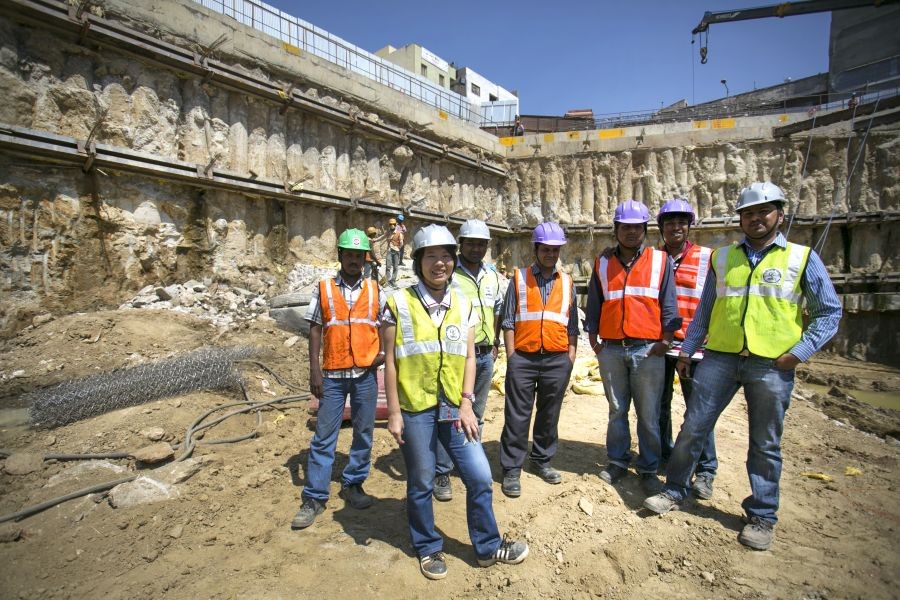
Abe didn’t exactly wish to change professions in her 40s. As the Taiwan High Speed Rail project approached its end and the number of overseas projects taken on by the company started to decline, she was beginning to lose her place at the company. It was then that another one of her seniors from Kobe University came to the rescue as a go-between for a new position.
Her new place of work was a construction consulting company that worked on overseas projects. It was there that her connections to India began. Initially, she planned on working for just three months in southern India’s Bengaluru, but they needed a supervisor for tunnel construction for the Delhi Metro, so she was sent there instead.
“The Indian employees I met initially and the people from Delhi Metro Rail Co., Ltd. made a fuss when a woman showed up, since they don’t write their gender or attach photos to resumes overseas. No one in India would know that I’m a woman just by seeing the name ‘Reiko,’ either.”
There was also some friction between Abe and the men in India. There, college-educated male engineers were the elite, so they had no experience being directed by a woman. When she was reprimanding an engineer about worker safety, that individual, along with several other male employees, were furious.
“I don’t think it would have happened with a male superior, but it was my fault. After that incident, I began to respect the communication style in India. I also started to realize that people will understand me if I speak to them sincerely as a fellow engineer.”
The sense of time in India is also very different than that of Japan. “If they say ‘in five minutes,” they usually mean in about an hour. Even if they show up late for meetings, they’ll tell you with a straight face, ‘Madam, let’s start with some tea.’ When they do that, I softly warn them by saying, ‘Tea isn’t going to solve this,” Abe smiled wryly.
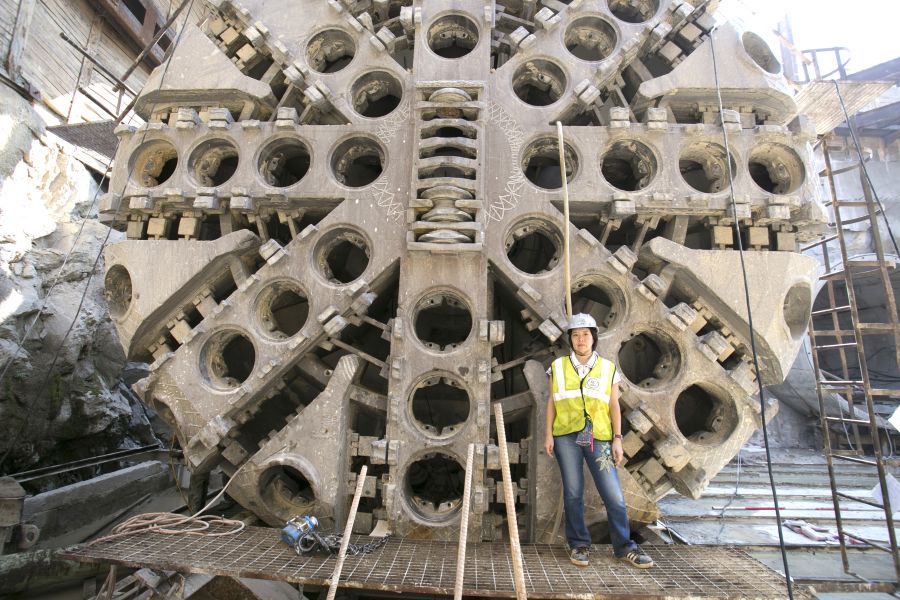
“Changing people’s lives” is the emotion that drives her
The metro construction in Delhi made use of Official Development Assistance (ODA) from Japan and was a huge project that saw participation from Japanese corporations and the Japan International Cooperation Agency. Abe poured a particularly large amount of energy into safety measures.
Before the start of construction on the Delhi Metro, it wasn’t a given in India that people wear basic safety equipment like helmets and safety boots or fence off construction sites. During the first construction period, Japanese engineers gave orders regarding safety measures, but once the second construction period had begun, there were clearly some corners being cut. As a result, though it was outside of the site that Abe was in charge of, there were serious fatal accidents.
It was then that they incorporated a safety monitoring system developed by Professor AKUTAGAWA Shinichi (now professor emeritus) of Kobe University’s Graduate School of Engineering. This system detects things like contortions in structures on construction sites and uses different colors of LED signals to display danger levels, serving as an important safety measure to protect workers’ lives. After construction of the Delhi Metro, this system was also incorporated at Bengaluru and other construction sites both inside India and abroad.
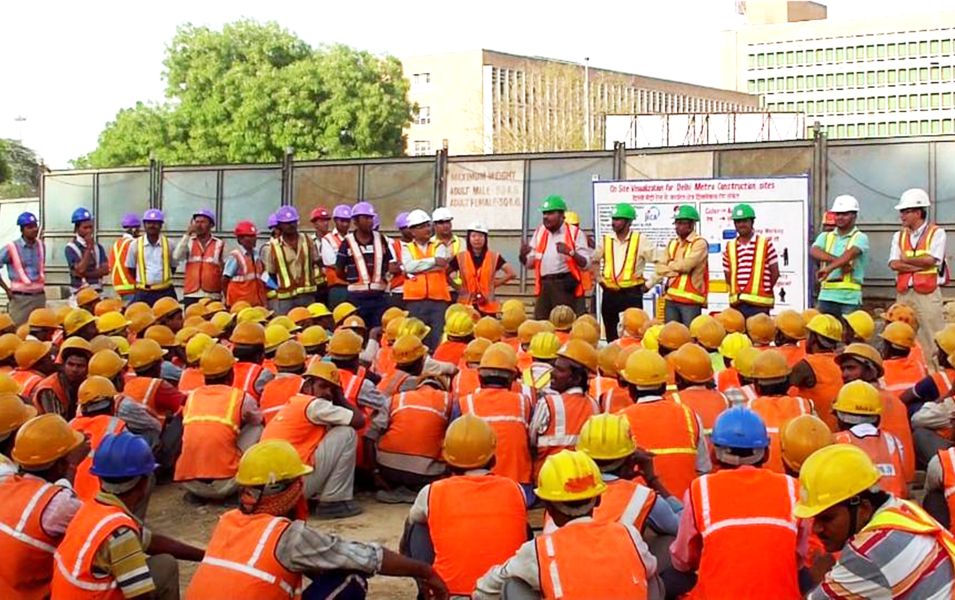
In order to pass on these lessons and experiences on safety measures to the next generation, Abe wrote her doctoral thesis while she was working. She mentioned an unforgettable experience while she was working on the Bengaluru Metro, one that would serve as the impetus for continuing to work in India. It was something the driver of one of India’s three-wheeled auto rickshaws proudly said to Abe while they were stuck in traffic caused by Metro construction.
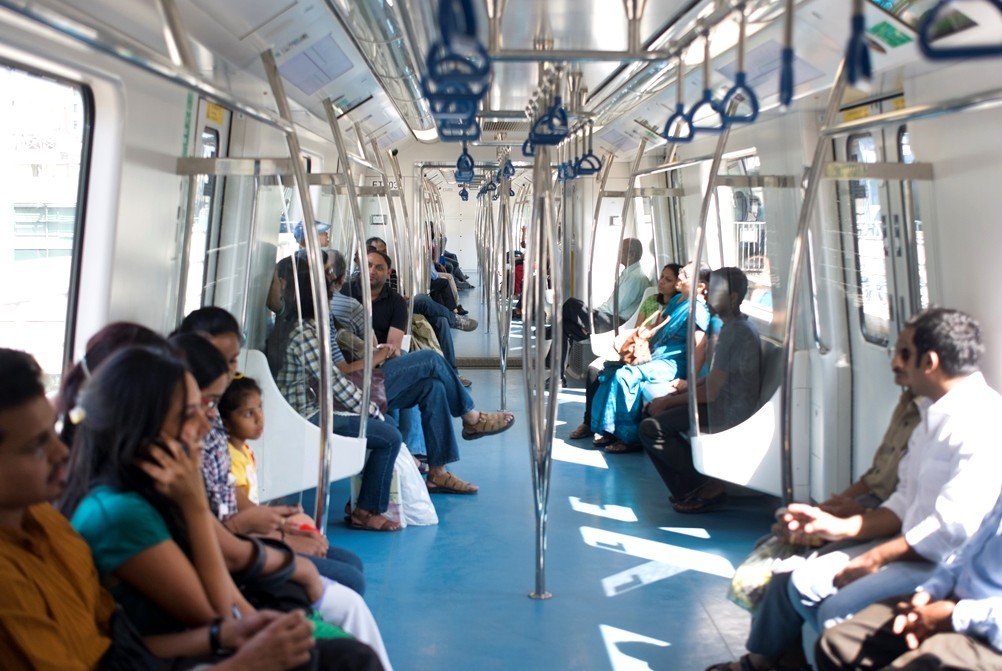
“Madam, this is our Metro. Amazing, isn’t it?” This wasn’t a complaint about the traffic, but rather, a message of joy from a citizen about a future where the Metro runs right through their city.
“I thought, ‘This is the same as when the Shinkansen began service in Japan after the war.’ Perhaps this was even a statement of pride, like ‘We’ve joined the rest of the developed world.’ After hearing what he said, I got a real sense that I was involved in an important project that would greatly change the way the people of India live their lives.”
The Delhi Metro has now become an essential means of transport for its citizens, praised for its convenience and safety and serving some 5 million riders each day. It’s also said to be the first public transportation system in India in which women can ride with peace of mind, which has contributed to women’s advancement in society.
To the next generation: “You can take detours”
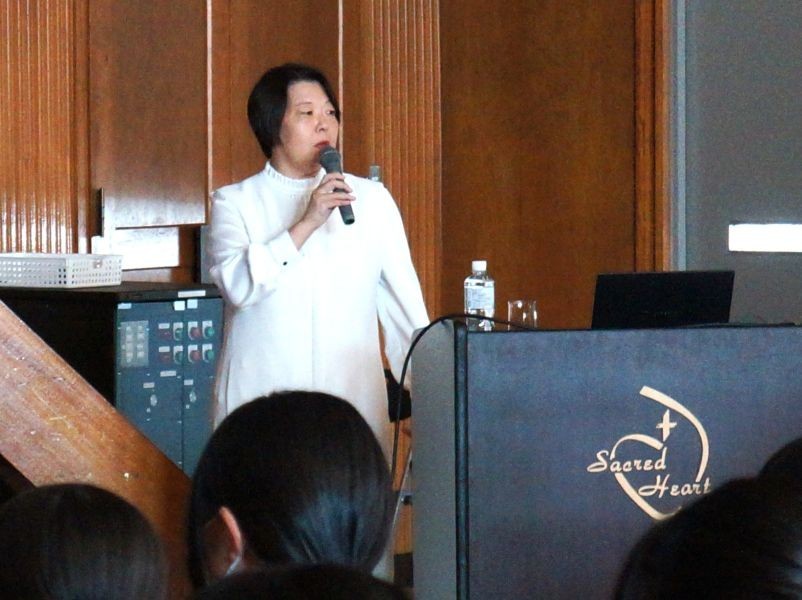
Abe now works as the chairperson of a local subsidiary, where she is in charge of some 400 employees as they work towards opening India’s high-speed rail line. Her interactions with Kobe University alums living in India are serving to support her in these busy days.
“There are quite a few employees at Japanese companies that shy away from living in India, but I get the feeling that Kobe University alums are sort of naturally free-spirited when it comes to their work,” Abe tells us. Their work involves manufacturing, shipping, infrastructure, finance, ocean vessels and more, and the faculties they come from are just as diverse. “There are so many people who are great at discovering interesting things despite living a hard life; they’re really adaptable. It’s very characteristic of Kobe University alums, I’d say.”
These past few years, Abe has also had more opportunities to speak to high school and university students about the appeal of her work and her personal experiences when she’s back in Japan. Since 2018, she’s also been active as part of the STEM Girls Ambassadors, which were commissioned by the Japanese central government to increase interest in science fields among female students.
“I don’t really like strong expressions like ‘Never give up.’ You can stop where you are. You can take detours. Just think to yourself ‘that will be me someday’ and move forward at your own pace. That’s what I want to tell the next generation.”
Her empowering message is filled with the resilience she’s gained from her harsh trials and the open-mindedness she’s developed as a leader.
Resume
In 1987, graduated from Faculty of Engineering, Yamaguchi University. In 1989, completed the master’s program at the Department of Civil Engineering, Graduate School of Engineering, Kobe University and joined Konoike Construction Co., Ltd. While at Konoike Construction, from 1995-1997, completed the master’s program at the Department of Geotechnical Engineering, Faculty of Engineering Science, Norwegian Institute of Technology. In 2004, joined Pacific Consultants International (the predecessor of her current position). In 2014, completed the doctoral program at the Department of Construction System Engineering, Graduate School of Engineering, Yamaguchi University and received her doctorate in engineering. Also in 2014, became CEO and in 2018, became chairperson of Oriental Consultants India Pvt., Ltd. In 2022, also became executive officer at Oriental Consultants Global Co. In 2013, received the Nikkei Woman of the Year Award in the Leaders Division. In 2023, received the Minister’s Award at the Ministry of Land, Infrastructure, Transport and Tourism’s 2022 Minister’s Award for Outstanding International Infrastructure Engineer. In 2025, received the Civil Engineering Achievement Award from the Asian Civil Engineering Coordinating Council. In 2026, received the International Lifetime Contribution Award from the Japan Society of Civil Engineers.